Needing more help rarely happens overnight. It usually shows in small changes that families notice over weeks or months, often during a visit home. Spotting them early means more choices, and a better chance of putting help in place before a crisis.
First: changes that need urgent help
Some changes cannot wait for a conversation.
- Sudden confusion, such as not knowing where they are, unusual drowsiness or agitation that starts over hours or days. The NHS advises going to A&E or calling 999 if someone suddenly becomes confused. Infections, including urinary tract infections, are a common cause in older people.
- Signs of a stroke: face drooping, arm weakness, slurred speech. Call 999.
- A fall with an injury, a head injury, or being unable to get up. Call 999.
- Chest pain or severe breathlessness. Call 999.
For urgent advice when it is not an emergency, call NHS 111.
Personal care and appearance
Signs: wearing the same clothes for days, body odour, unwashed hair, untrimmed nails, sore or broken skin, wet or soiled clothes or bedding.
What to do:
- Ask gently whether getting in and out of the bath has become difficult. Often the cause is fear of falling, not neglect.
- Ask the council for an occupational therapy assessment: rails, a bath lift or a level shower can restore independence.
- Bladder or bowel problems are common and often treatable. See continence care with dignity.
- Help with washing and dressing is exactly what visiting or live-in carers provide.
Eating and drinking
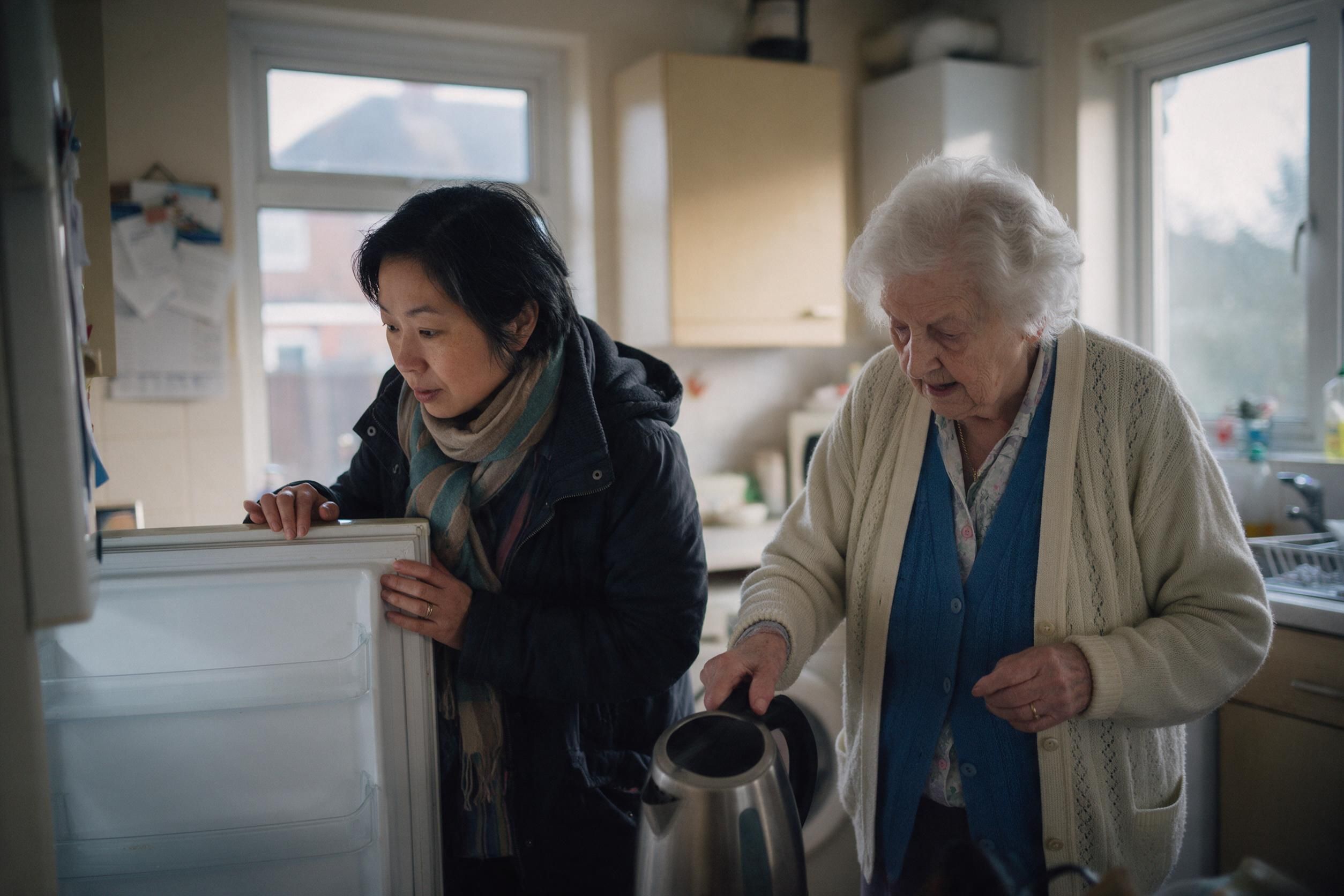
Signs: an empty or out-of-date fridge, clothes or rings becoming loose, little interest in food, dark urine, frequent infections, tiredness.
What to do:
- The NHS describes losing 5% to 10% or more of body weight over 3 to 6 months without trying as a main sign of malnutrition. Ask for a GP appointment.
- Ask for a dental or swallowing check if eating seems uncomfortable.
- Try meal deliveries, a lunch club or a carer who prepares meals and eats with them. See nutrition and hydration.
The home
Signs: piles of washing-up, a cold house in winter, scorch marks on pans, rubbish building up, rooms no longer used, stairs avoided, sleeping in a chair.
What to do:
- The NHS advises heating the rooms someone regularly uses to at least 18°C. Check the heating works and is affordable: see other benefits and help.
- Ask the local fire and rescue service about a free home fire safety visit, and work through our home safety checklist.
- Sleeping downstairs may point to difficulty with the stairs: an occupational therapist can advise.
- Severe clutter or neglect of the home can be self-neglect. If the person refuses help and is at risk, contact the council’s adult social care team.
Money, post and scams
Signs: unopened post, final demands, unusual withdrawals, new “friends”, lots of catalogues or prize letters, doorstep traders, cold callers.
What to do:
- With their permission, help sort the post and set up direct debits.
- Suggest a Lasting Power of Attorney for property and financial affairs while they can still make one. See Lasting Power of Attorney.
- If you suspect a scam or financial abuse, read safeguarding and scams and act quickly.
Memory, mood and behaviour
Signs: repeating questions, missing appointments, getting lost on familiar routes, losing interest in hobbies, withdrawing from friends, low mood, irritability, poor sleep.
What to do:
- The NHS advises seeing a GP if someone has gradually become more forgetful or confused. Depression, hearing loss, thyroid problems and medicine side effects can all affect memory and are treatable.
- If dementia is diagnosed, see our dementia care at home guide.
- Loneliness is a real health risk. See loneliness and wellbeing for practical ideas.
Moving about and falls
Signs: holding on to furniture, new bruises, a fall they “forgot to mention”, fear of going out, shuffling or slower walking.
What to do:
- Tell the GP about any fall. Ask for a medication review and a referral to a local falls service if offered.
- A personal alarm or fall detector can bring help quickly. See falls prevention and technology and telecare.
Medicines
Signs: full blister packs, tablets on the floor, running out early, confusion about what to take, repeat prescriptions not collected.
What to do:
- Ask the GP or pharmacist for a medication review: some people take more medicines than they need.
- Ask about simpler timings, larger labels or reminder devices.
- Carers can prompt or give medicines as set out in the care plan. See managing medication at home.
Driving
Signs: new dents or scratches, getting lost, near misses, other drivers sounding horns, family feeling unsafe as passengers.
What to do:
- Drivers must renew their licence every 3 years from age 70, and confirm they meet the eyesight rules.
- Drivers with dementia must tell the DVLA. Not reporting a condition that affects driving can lead to a fine of up to £1,000.
- If you are worried, talk to the GP. Plan alternatives, such as lifts, community transport, taxis or a carer who drives, before giving up the car.
The family carer is exhausted
If you or another relative are providing more and more help, and feeling worn out, that is a sign too. You are entitled to a free carer’s assessment, and our guide to looking after yourself as a carer can help.
A one-week checklist to print
Tick what you see, and note the day:
- Fridge and cupboards stocked, with food in date
- Eating at least two proper meals a day
- Drinking regularly
- Washed and in clean clothes
- Medicines taken as prescribed
- House warm (at least 18°C in rooms used)
- Post opened and bills paid
- No new bruises, falls or near misses
- Getting out, or seeing other people
- Mood and memory as usual for them
- Sleeping in bed, not in a chair
- Any new worries from neighbours or friends
Take the completed list to a GP appointment or the needs assessment. It turns “I’m worried” into facts professionals can act on.
Your first steps
- Talk with the person. Start with what you have noticed and what matters to them. See talking to a parent about care.
- Book a GP check, especially if anything has changed recently.
- Ask the council for a needs assessment. It is free and anyone can ask. In Oxfordshire, call 01865 519800 (Monday to Thursday 8.30am to 5pm, Friday 8.30am to 4pm). Elsewhere, find your council on GOV.UK. See care assessments and care plans.
- Check benefits. Attendance Allowance is not means-tested and is paid at £76.70 or £114.60 a week in 2026/27. See Attendance Allowance.
- Ask for advice if you are unsure: the Age UK Advice Line is on 0800 678 1602, 8am to 7pm every day.
You could say to the council: “I’m calling about my mother, [name, address, date of birth]. Over the last two months she has lost weight, stopped washing regularly and had two falls. She agrees to an assessment. Please can you arrange one, and tell me how long it is likely to take?”
What kind of help might suit
Help can start small and grow: a few home care visits a week, daily visits, night care or a live-in carer who lives in the home, giving company and support through the day and close by at night, while the person stays at home. Some people are better suited to a care home, for example if they need nursing care day and night or feel lonely living alone. Our guide to types of care at home compares the options.
What to do next
- Use the one-week checklist on your next visits.
- Act the same day on any sudden change.
- Talk to the person, then book a GP check.
- Ask for a free council needs assessment and a benefits check.
How we can help
Day and Nightcare has supported older people at home since 2008, with home care visits, waking nights and sleep-ins across Oxfordshire and fully managed live-in care anywhere in England, from £1,550 a week. We are registered with CQC and rated Good. If you are noticing some of these signs, call us on 01865 715780 for a free initial assessment; we will talk through what would help, including options that are not ours.
Common questions
How do I know if it is normal ageing or something more?
Look at the pattern and the pace. Slowing down a little, or taking longer to recall a name, is common with age. Changes that affect daily life, such as not eating properly, getting lost in familiar places, missing bills or falling, are not just ageing and deserve a GP check. Many causes are treatable, including infections, medicine side effects, low mood, hearing loss and vitamin deficiencies. A sudden change is always a reason to seek help quickly.
What if they hide how much they are struggling?
It is very common, often out of pride or fear of losing independence. Visit at different times of day, look in the fridge and the post pile, notice whether the same clothes are worn, and listen to neighbours or friends. Keep a dated note of what you see. Then talk gently about specific things you have noticed, rather than general worries. Our guide to talking to a parent about care has word-for-word scripts.
Who can ask for a needs assessment?
Anyone can ask the council for a needs assessment, including a son, daughter, neighbour or GP, and it is free whatever the person's savings. It works best with the person's agreement, and an adult with capacity can refuse it. The council must still assess if they are at risk of abuse or neglect, including self-neglect, or if they lack capacity to refuse and an assessment would be in their best interests.
Does needing more help mean a care home?
No. Most older people who need more help get it at home: a few visits a week, daily visits, night care or a live-in carer, often alongside equipment and telecare. A care home may suit better for some people, for example when nursing is needed around the clock or someone feels isolated at home. The right answer depends on their needs and wishes, and a needs assessment is a good starting point.
Sources and further information
- NHS: Getting a needs assessment
- NHS: Confusion
- NHS: Malnutrition
- NHS: Keep warm, keep well
- GOV.UK: Dementia and driving
- GOV.UK: Renew your driving licence if you're 70 or over
- Age UK: Advice Line
Prepared by the Day and Nightcare care team. Last updated 30 October 2026; sources last checked 30 October 2026. This guide is general information about care in England, not financial, legal or medical advice.