
Role essentials
The roles, and what you will need
Live-in carers
As a live-in carer, you live in a client's home and support them with personal care, medication support, meals, the home and good company. You will have your own room, a daily break and regular time off. When you start a placement, you have a full handover of the person's routine, preferences and medication, so you know them before you begin.
Home care and night care in Oxfordshire
Our care workers visit people in their own homes across Oxfordshire, from short calls to longer sitting visits, as well as waking nights and sleep-ins. A driving licence and car are helpful in rural areas.
The right to work in the UK and an enhanced DBS check (we arrange it). Live-in roles need care experience; if you are new to care, home care roles are a good place to start, with full training and shadowing before you work on your own.
Your first weeks
A thorough induction
Before you work on your own, you will:
- Work through the Care Certificate.
These are the national standards every new care worker in England learns, from duty of care, privacy and dignity to safeguarding and infection control. You are assessed on what you know and on how you work in practice.
- Practise with a trainer.
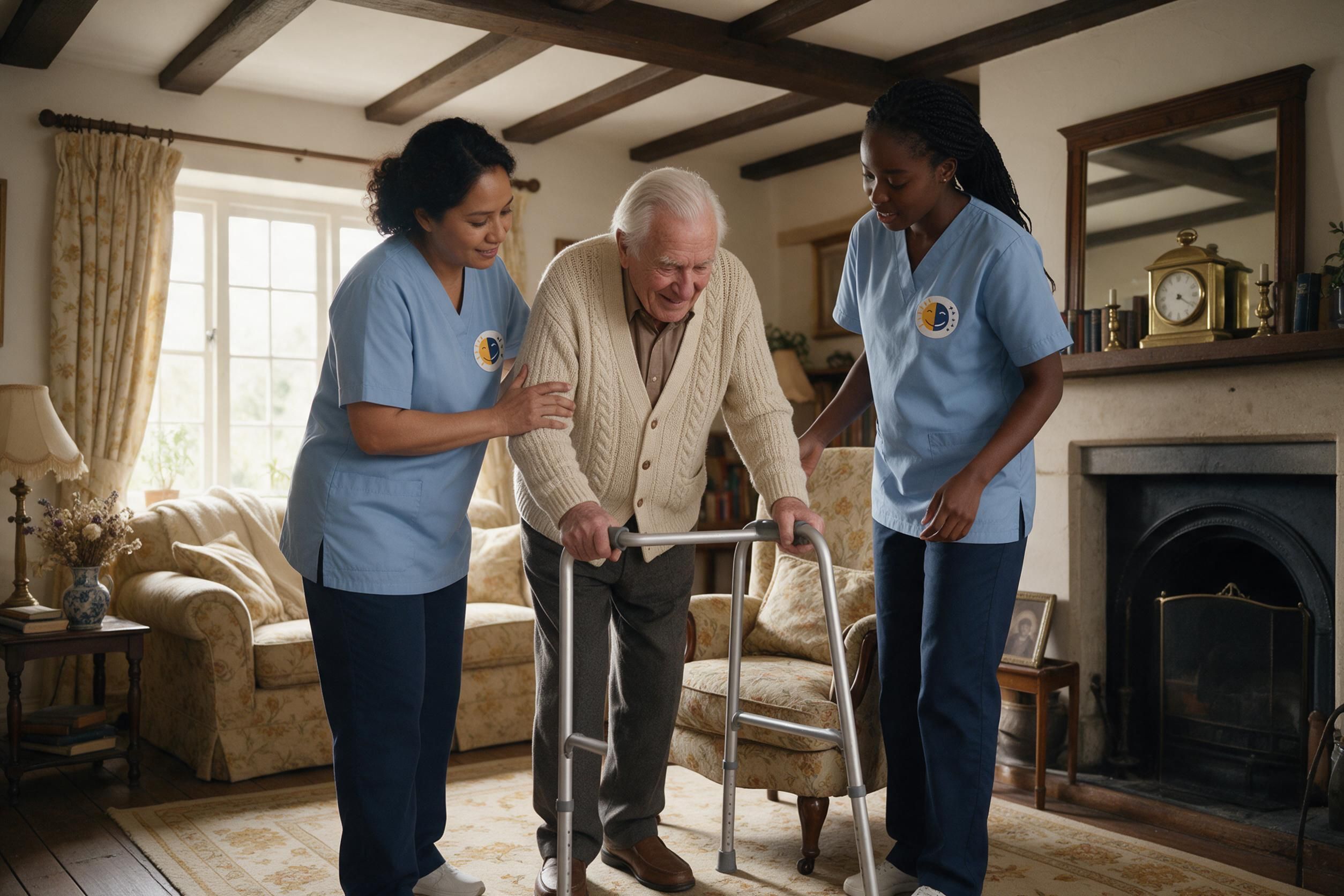
In small groups and one to one, you practise practical skills such as moving and handling, and you can ask as many questions as you need.
- Shadow an experienced carer.
You work alongside one of our experienced carers, getting to know the people we support and how we do things.
Read more: the 16 Care Certificate standards
The standards are written by Skills for Care, Skills for Health and NHS England, and were updated in 2025, when awareness of learning disability and autism became the 16th standard (see sources).
- Understand your role
- Your personal development
- Duty of care
- Equality, diversity, inclusion and human rights
- Work in a person-centred way
- Communication
- Privacy and dignity
- Fluids and nutrition
- Awareness of mental health and dementia
- Adult safeguarding
- Safeguarding children
- Basic life support
- Health and safety
- Handling information
- Infection prevention and control
- Awareness of learning disability and autism
Learning
Training that keeps going
Learning does not stop after your induction:
- One-to-one training, including when you want more confidence in something or a client's needs change
- Upskilling for the care our clients need, such as dementia care, end-of-life care and helping people settle back home after hospital
- Online courses on our online training portal, to refresh and build your knowledge
When you need a new skill, for example because the needs of the person you support change, we can combine an online course with one-to-one practical training, and supervision and spot checks help us see how it is going in practice and what support you still need.
If you would like to work towards a nationally recognised qualification, such as the Level 2 Adult Social Care Certificate or the Level 3 Diploma in Adult Care, talk to us about it.
Read more: qualifications in adult social care
The Level 2 Adult Social Care Certificate, introduced in 2024 and regulated by Ofqual, is the qualification Skills for Care recognises as the preferred standard for people starting out in care. It includes assessment of your practice and usually takes a new learner around six to eight months. Experienced carers can go on to the Level 3 Diploma in Adult Care, and Level 4 and Level 5 diplomas lead towards senior and management roles.
Source: Skills for Care (see sources).

Our online training portal
Our online training portal gives our team a library of nearly 100 online care courses, almost all of them CPD-certified. The whole library is available to our carers, but a course being available is not the same as every carer having completed it: which courses each carer completes depends on their role and the needs of the people they support. CPD certification means a course counts towards continuing professional development; it is not a qualification in itself, which is why practical skills are also taught in person and checked through shadowing, spot checks and supervision for the needs of the people each carer supports.
Our current staff have earned more than 10,000 course certificates and logged over 4,000 CPD hours on our training portal. These totals count courses completed on the portal, including refresher courses, not carers: one carer can hold many certificates. They are not qualifications, and they do not show practical competence on their own.
The library includes:
Induction
The Care Certificate, standard by standard, and introductions to dementia, end-of-life care, mental health, autism and lone working.
Everyday essentials
Moving and handling, medication practice and fire safety written for care at home, infection control, food hygiene, first aid and basic life support.
Safe, respectful care
Safeguarding adults, mental capacity, duty of care, dignity, person-centred care, professional boundaries and recording information.
The conditions our clients live with
Dementia, Parkinson's, stroke, diabetes, epilepsy, multiple sclerosis, motor neurone disease and sepsis.
Specialist care
Catheter care, stoma care, pressure area care, dysphagia, oral care, continence care and buccal midazolam.
Learning disability and autism
Including the online (e-learning) part of The Oliver McGowan Mandatory Training on Learning Disability and Autism. The full training also has a live interactive part, a webinar or a face-to-face day depending on the tier, which is not part of the online course.
Completed courses and certificates are recorded on the portal.
Support
Never on your own
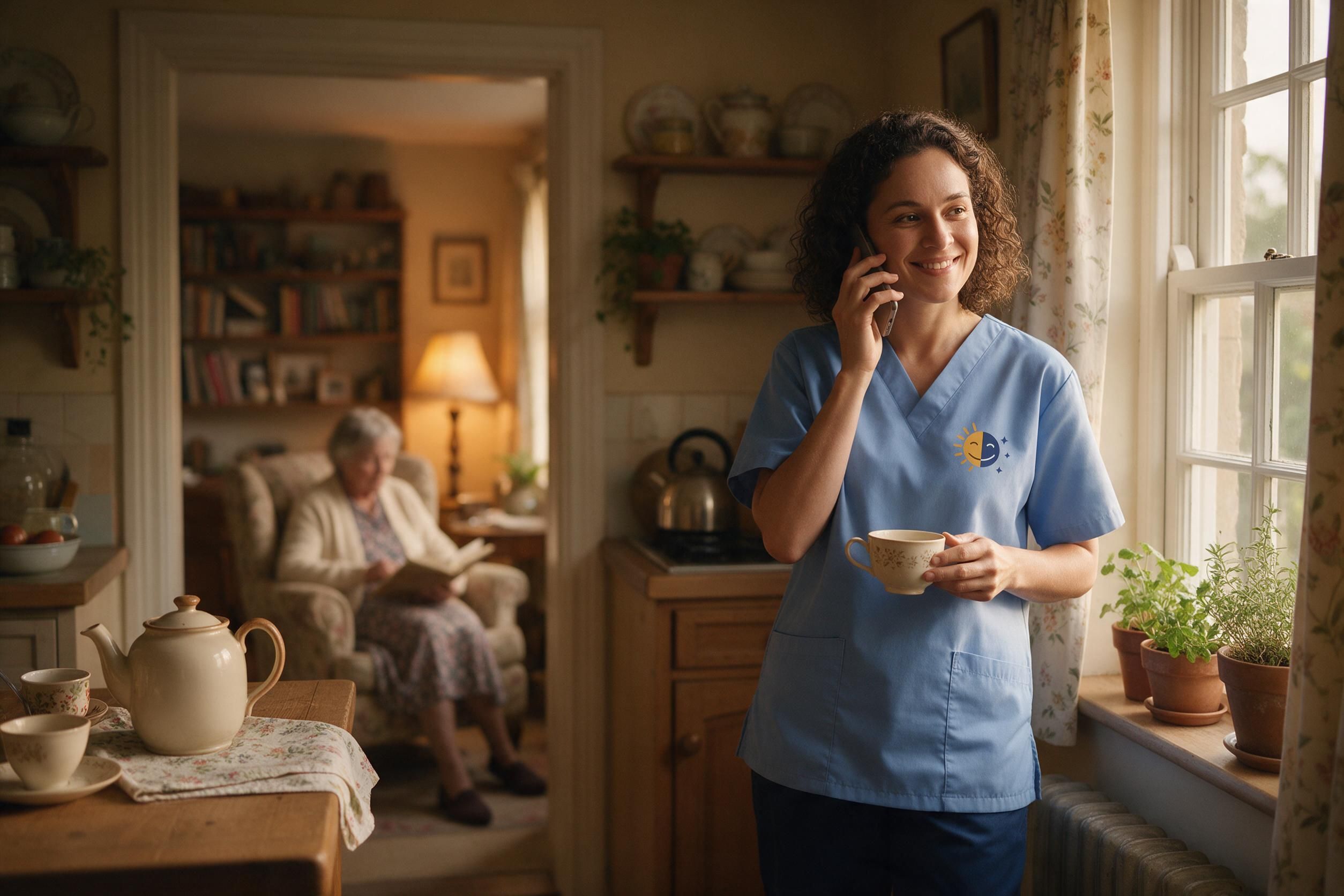
Caring for someone, especially as a live-in carer, can feel like a lot to carry. With us, there is always someone to call, and you are part of a team.
- Our care team answers the phone in office hours (Monday to Friday, 9am to 5pm), for you as much as for the people we support
- Outside office hours, a manager is on call, every evening, night, weekend and bank holiday
- Records and alerts in our live care monitoring system, so the team can follow up concerns about the person you support or about you
- Spot checks and regular supervision, so a manager sees how you are getting on, talks through what you would like to learn and helps with anything that would make your work easier
- A yearly appraisal to look back on your progress and plan what comes next
- When you have time off, a relief carer takes over after a full handover, so you can rest properly
Records and alerts
Our live care monitoring system
Everything about a person's care is held in our digital care system and updated from our care app as carers record care: every task, every medication, assessments, care plans, carer notes and alerts.
- Care plans and assessments are in the app, so you can check what the person needs and how they like things done.
- Every task and every medication is recorded as you go, giving a clear, accurate record of the care given.
- Carer notes about the person's day, their mood and anything new are visible to our care team as you enter them.
- Alerts flag to our care team when something needs attention. The team reviews alerts during office hours and follows up; outside office hours, the on-call manager deals with urgent alerts.
For the people we support and their families, this means a record of care that our team can check as it is entered, rather than weeks later. With the agreement of the person receiving care, relatives can see care notes through our family app. For you, it means the team can see how things are going and offer support early, before a small worry becomes a bigger one.
Your career
A career in care, not just a job
Care is a career with real routes forward. The government's Care Workforce Pathway sets out how roles in adult social care connect, from new to care, care worker and enhanced care worker to supervisor, deputy manager and registered manager, with the values and skills each one needs. Whether you would like to specialise in dementia or end-of-life care or move into a supervisory role, talk to us about your next step.
Source: GOV.UK (see sources).
Whether you are arranging care for yourself or for someone else, this page shows how our carers are prepared and supported. You can read more about how live-in care works day to day and about us.
Applying
How to apply
- Get in touch.
Call us on 01865 715780, or leave your details below and we will call you back.
- A chat and an interview.
We talk about you, your experience and the kind of work that suits you.
- Your checks.
We arrange your enhanced DBS check, take up references and check your right to work in the UK.
- Induction and training.
Then your first shifts alongside an experienced carer (see induction).
If you need any adjustments to apply or to come to an interview, just let us know.
Thank you, we have your details.
We will call you to talk about working with us. If you would rather talk now, call our office on 01865 715780.
Please add your name and a phone number we can call, then send your details again.
Sorry, your details did not reach us. They are still in the form below, so please try again in a few minutes, or call our office on 01865 715780.
Sources and further information
- Skills for Care: Care Certificate standards (the 16 standards and how new care workers are assessed)
- Skills for Care: qualifications in adult social care (the Level 2 Adult Social Care Certificate and the Level 3 to 5 diplomas)
- GOV.UK: Care Workforce Pathway for adult social care
The course, certificate and CPD-hour figures are for our current staff, from our own training records, October 2026.
Prepared by the care team at Day and Nightcare Live In Limited. Last updated 30 October 2026.