
How dementia affects daily life at home
Dementia is a group of conditions, Alzheimer’s disease and vascular dementia being the most common, that gradually affect memory, thinking, communication and everyday skills. Everyone’s experience is different, but the Alzheimer’s Society describes three broad stages. They are only a rough guide, and people move through them at very different speeds.
- Early stage: mild memory lapses, repeating questions, losing track of appointments or bills. Most people manage much of their own life with some prompting. This is the time to plan ahead.
- Middle stage: often the longest. Confusion about time and place grows, people may not recognise familiar faces, and help is needed with washing, dressing, meals and medicines. Changes in mood, restlessness and unsettled evenings are common.
- Later stage: the person needs help with most things, may speak little, can have difficulty swallowing and becomes physically frail. Comfort, closeness and good personal care matter most.
Through every stage, the person is still themselves. Their history, likes and relationships do not disappear, and good care is built around them.
How to communicate with someone who has dementia
Communication changes, but connection remains possible. The NHS and dementia charities suggest:
- Speak clearly and calmly in short sentences, and give plenty of time for an answer.
- Offer simple choices (“tea or coffee?”) rather than open questions.
- Turn down the television or radio, and sit at eye level, face to face.
- Use their name, a warm tone and, if they welcome it, a gentle touch on the hand.
- Listen for the feeling behind the words. Distress often signals an unmet need: pain, hunger, thirst, the toilet, boredom or being too hot or cold.
- Check glasses are clean and hearing aids are working; sight and hearing loss make confusion worse.
Why routines matter
A predictable day reduces anxiety. Keep getting up, meals, personal care, outings and bedtime at roughly the same times, in the same order. Build in things the person enjoys and is still good at, such as folding laundry, gardening, music they love, looking at photographs or a daily walk. A simple life story book or “about me” sheet helps every carer, whether family or professional, know what matters to them.
Eating and drinking well
People with dementia often forget to eat, lose interest in food or do not notice thirst, which raises the risk of weight loss, constipation and urinary infections. Helpful habits include:
- Smaller meals and snacks through the day, using foods they have always liked.
- Finger foods if cutlery has become difficult.
- Drinks offered often, in a clear glass or brightly coloured cup that is easy to see and hold.
- Eating together, without rushing, in a calm room.
- Regular dental checks, because a sore mouth or loose dentures can stop someone eating.
If you notice coughing at meals, weight loss or refusal of food, speak to the GP, who can refer to a speech and language therapist or dietitian. Our guide to nutrition and hydration has more ideas.
Sundowning and unsettled nights
Many families notice that agitation, confusion or distress increases in the late afternoon and evening. This is often called sundowning. Possible causes include tiredness, hunger, pain, too little daylight, a noisy environment and a disrupted body clock. Things that often help:
- Plenty of daylight and activity earlier in the day, with only short naps.
- Closing curtains at dusk and covering unused screens and mirrors, as shadows and reflections can frighten.
- Less caffeine and alcohol in the afternoon and evening.
- A calm, familiar bedtime routine, a night light and a clear route to the toilet.
Disturbed nights are one of the main reasons family carers become exhausted. This is where night care or a live-in carer can make the biggest difference: someone is there to reassure, help to the toilet and settle the person again, so the family can sleep.
Walking about, getting lost and staying safe

Walking about can be a sign of restlessness, boredom or searching for something, such as “going home” or “going to work”. Rather than stopping it, try to understand it: a daily walk together often reduces the urge. To keep someone safe:
- Ask the council’s adult social care team about telecare, such as door sensors, falls detectors and GPS locators.
- Keep a recent photo and a short description ready. Many police forces run the Herbert Protocol, a form you fill in now so police can act quickly if someone goes missing.
- Consider cooker isolation valves, thermostatic taps and smoke alarms linked to a monitoring centre.
- Watch out for scams and doorstep callers; ask the bank about extra protections.
Mental capacity and Lasting Power of Attorney
A diagnosis does not mean someone has lost capacity. Capacity is about a specific decision at a specific time, and people must be helped to make their own decisions wherever possible.
A Lasting Power of Attorney (LPA) lets the person choose trusted people to make decisions if they no longer can. There are two types: property and financial affairs, and health and welfare. An LPA can only be made while the person has capacity, so it is worth doing soon after diagnosis. Registration with the Office of the Public Guardian costs £92 for each LPA, with reductions or exemptions for people on low incomes or certain benefits. Without an LPA, the family may need to apply to the Court of Protection for deputyship, which is slower and more expensive. See our guides to Lasting Power of Attorney and mental capacity and best interests.
Looking after yourself as a carer
Caring for someone with dementia is demanding, and family carers’ own health often suffers. You are entitled to a free carer’s assessment from the council, which can lead to breaks, practical help and training. Tell the GP practice you are a carer. Plan regular breaks before you reach crisis point, using day centres, sitting services or respite care. Check whether you can claim Carer’s Allowance, and see our carers’ assessment guide for what to ask for.
When needs increase
Signs that more support is needed include frequent falls, nights with little sleep for anyone, weight loss, incontinence that is hard to manage, distress when alone, or a family carer who is unwell or worn out. The options are more home care visits, regular night care, live-in care, or a care home.
Live-in care suits many people with dementia because it keeps them in familiar surroundings with a consistent carer, or a small team of regular carers, who learn their routines and moods. A care home may suit better when someone needs two people to move them at all hours, needs nursing care around the clock, or seems happier with more company. Our comparison of live-in care and care homes sets out the trade-offs honestly.
How dementia care is paid for
- Attendance Allowance: for people over State Pension age who need help with personal care or supervision. It is not means-tested and pays £76.70 or £114.60 a week, the higher rate when help is needed both day and night. See our Attendance Allowance guide.
- Council funding: a free care needs assessment, then a financial assessment. In England, people with capital over £23,250 usually pay in full; below £14,250, capital is ignored. The home is not counted when care is provided at home.
- NHS Continuing Healthcare: pays the full cost of care when needs are mainly health needs, assessed on the whole picture, not the diagnosis. Behaviour that is challenging, unpredictable or risky can count. See our NHS Continuing Healthcare guide.
- Council tax: someone certified by a doctor as having a severe mental impairment, and receiving a qualifying benefit such as Attendance Allowance, is disregarded. If they live alone, the bill can be reduced by 100%; if one other adult lives with them, a 25% discount may apply. Our council tax guide explains how to apply.
When to call the GP, 111 or 999
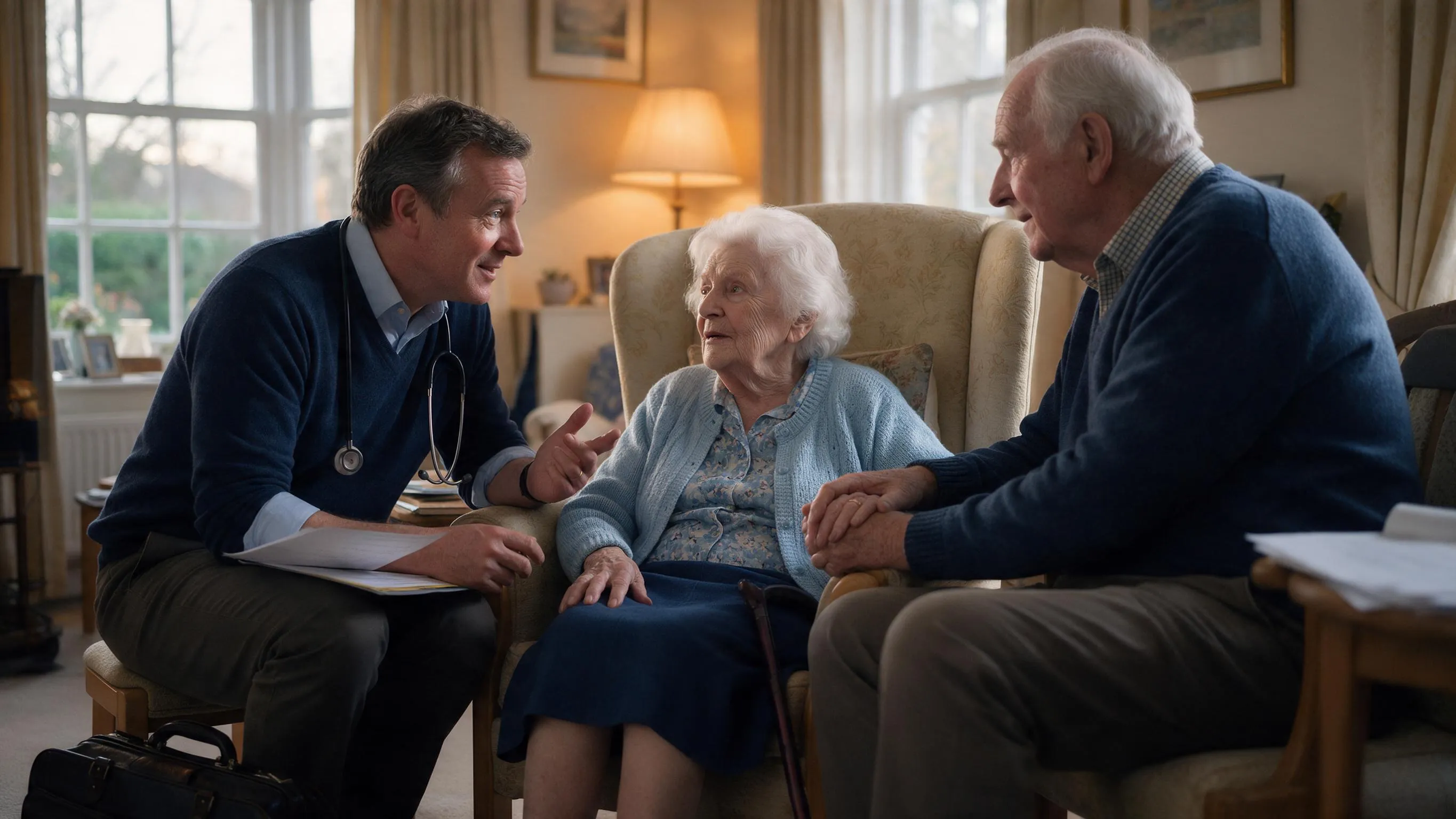
Dementia usually changes slowly, so a sudden change is a warning sign of something else, such as an infection, dehydration, a stroke or a side effect of medicine.
Call 999 if the person:
- Suddenly becomes much more confused, very drowsy or has difficulty speaking.
- Shows signs of a stroke: face drooping, arm weakness or slurred speech.
- Has fallen and may have hurt their head, neck, back or hip, or cannot get up.
- Is choking and it does not clear, or is struggling to breathe.
Ask for an urgent GP appointment or call NHS 111 (free, 24 hours) if they:
- Have signs of a urine infection, such as new agitation, shivering or more leaking than usual.
- Have barely eaten or drunk for a day, have dark urine or feel dizzy on standing.
- Start coughing or choking when eating or drinking.
Book a routine GP appointment for gradual changes in memory, mood, sleep or behaviour, weight loss, or a medication review.
How to get NHS and council help, step by step
- Memory concerns: book a GP appointment. The GP checks for other causes and can refer to the local memory assessment service.
- After diagnosis: ask who your named contact is. NICE recommends that everyone with dementia has a named health or social care professional coordinating their care. GP practices usually offer a dementia care review once a year.
- Care at home: phone or apply online to the council’s adult social care team for a free care needs assessment. Ask about an occupational therapist for equipment and about telecare.
- The family carer: ask the council for a carer’s assessment, and tell the GP practice you are a carer.
- Specific needs: ask the GP or district nurse for referrals to the continence service, a speech and language therapist (eating or swallowing) or the falls service.
- Complex needs: ask the GP, district nurse or social worker to complete an NHS Continuing Healthcare checklist.
Checklist: keep by the phone
- GP surgery, NHS 111 and the person’s NHS number.
- A current list of medicines, allergies and conditions.
- Names and numbers of attorneys, family and carers.
- Who holds keys, and the key safe code holder.
- A recent photo and the Herbert Protocol form, if completed.
- Any hospital “about me” sheet or care plan.
Where to get support
- Alzheimer’s Society Dementia Support Line: 0333 150 3456 (local rate). Monday to Wednesday 9am to 8pm, Thursday and Friday 9am to 5pm, weekends 10am to 4pm.
- Dementia UK Admiral Nurse Dementia Helpline: 0800 888 6678 (free). Weekdays 9am to 9pm, weekends and bank holidays 9am to 5pm.
- Age UK Advice Line: 0800 678 1602 (free). 8am to 7pm, every day of the year.
- Carers UK Helpline: 0808 808 7777. Monday to Friday, 9am to 6pm.
- Samaritans: 116 123 (free), 24 hours a day, if you are struggling.
- In Oxfordshire: Dementia Oxfordshire, run by Age UK Oxfordshire, offers free dementia advisers for people with a diagnosis and their families.
What to do next
- Ask the GP for a review and a medication check, and tell them you are the person’s carer.
- Request a free care needs assessment from the council’s adult social care team, and a carer’s assessment for yourself.
- Make or register Lasting Powers of Attorney while the person can still do so.
- Claim Attendance Allowance and apply for the council tax discount.
- Ask whether an NHS Continuing Healthcare checklist should be completed.
- Write a short “about me” sheet and keep a record of difficult days, nights and falls.
How we can help
Day and Nightcare has supported people at home since 2008. We provide fully managed live-in dementia care anywhere in England, from £1,550 a week, and home care visits, waking nights and sleep-ins across Oxfordshire, and 24-hour care with carers working in shifts anywhere in England. We work with private, council, direct payment and NHS Continuing Healthcare funding. If you would like to talk things through, call us on 01865 715780 to arrange a free assessment and a written quote.
Common questions
Can someone with dementia carry on living alone?
Often yes, particularly in the earlier stages, if the right support is in place and the risks are understood. Warning signs that living alone is becoming unsafe include missed meals, weight loss, leaving the cooker on, getting lost, falling for scams or not taking medicines. A diagnosis alone does not mean someone must move or have care they do not want. If they can still make the decision, it is theirs; if they cannot, it is made in their best interests, involving the family and any attorney.
Is dementia care free on the NHS?
Usually not in full. Diagnosis, treatment and specialist nursing are free, but help with washing, dressing, meals and supervision is social care, which the council means-tests. NHS Continuing Healthcare pays for all care when needs are complex, intense or unpredictable enough, but a dementia diagnosis alone does not qualify. Attendance Allowance is not means-tested and many people with dementia are entitled to it.
Should I correct someone with dementia when they get things wrong?
Usually it is kinder not to. Arguing about facts, such as the day of the week or whether a parent is still alive, rarely helps and can cause real distress. Respond to the feeling behind the words instead: 'You sound worried, let's sit down together.' Gentle reassurance and a change of activity often work better than correction. Safety matters are different: you may need to step in calmly, without blame.
What is the difference between a waking night and a sleep-in?
With a waking night, a carer stays awake all night, ready to help with toileting, repositioning, medicines or distress. With a sleep-in, the carer sleeps in the home and is woken only occasionally. A sleep-in suits someone who wakes once or twice; a waking night suits someone who is up often, at risk of falls at night or who tries to leave the house. A care assessment can help you decide.
What if my parent refuses all help?
This is very common, and it is rarely about the help itself. People fear losing control or being moved from home. Start small and familiar, such as company for a walk or help with lunch, and introduce a carer as a helper rather than a nurse. Involve the GP if needed. If the person lacks capacity for this decision, a best interests decision can be made, but never by force, and always the least restrictive option.
Sources and further information
- NHS: Looking after someone with dementia
- NHS: Communicating with someone with dementia
- NHS: Coping with dementia behaviour changes
- NHS: Dementia, social services and the NHS
- Alzheimer's Society: Stages of dementia and progression
- Alzheimer's Society: Sundowning and dementia
- GOV.UK: Council Tax discounts for disabled people
- GOV.UK: Register a lasting power of attorney
Prepared by the Day and Nightcare care team. Last updated 30 October 2026; sources last checked 30 October 2026. This guide is general information about care in England, not financial, legal or medical advice.