
Two kinds of assessment
Families often hear the word “assessment” from several directions at once. In care at home there are usually two:
- A council care needs assessment. Carried out by the council’s adult social care team under the Care Act 2014. It is free, and it decides whether the person has eligible needs and whether the council will help arrange or pay for care.
- A care provider’s assessment. Carried out by the home care or live-in care provider before care starts, so that it can plan exactly how it will support the person.
You can have both, and the first often helps the second. Even people who will pay for their own care benefit from a council assessment, because it gives an independent record of needs.
The council care needs assessment
Anyone who appears to need care and support can ask for a needs assessment, and the council must carry it out whatever it thinks about the level of the person’s needs or how much money they have. Contact the adult social care team at the council where the person lives, by phone or online.
The assessment can happen face to face, by phone or online, or as a supported self-assessment, where the person fills in the assessment and the council checks it. If there is any concern about the person’s capacity to make decisions, for example because of dementia, the assessment should be face to face.
It looks at:
- what the person finds difficult, and how that affects their wellbeing;
- the outcomes they want, such as staying at home, seeing friends or getting out;
- their own strengths and the support around them;
- any care a family member gives, recorded without affecting the decision about eligibility.
Family carers have a separate right to a carer’s assessment of their own needs.
How to ask for an assessment: what to say
Phone or write to the adult social care team (find your council at gov.uk/find-local-council). You could say or write:
I would like to request a care needs assessment under the Care Act 2014 for [full name, date of birth, address]. [He or she] is struggling with [washing, dressing, meals, medicines, getting about, nights] because of [condition]. [He or she] agrees to this request and would like me to be involved. I am [his or her] carer and would also like a carer’s assessment. Please confirm when the assessment will happen and who will contact us. If the needs are urgent, please tell me what can be arranged in the meantime.
Write down the date, the name of the person you spoke to and any reference number.
Documents and information to have ready
- A list of current medicines, and the GP’s name and surgery.
- Recent hospital, clinic and therapy letters.
- Details of any equipment already in use.
- A one-week diary of the help needed, day and night, including bad days.
- What family and friends do, and what they can no longer manage.
- Any Lasting Power of Attorney, advance care plan or emergency treatment plan.
- For the financial assessment later: bank statements, pension and benefit letters, and details of savings and investments.
Preparing for the day
- Ask for the assessment at a time when the person is usually at their best, and allow enough time.
- Describe a typical bad day, not only a good one. People often play down their difficulties to a stranger.
- Mention nights, falls, near-misses, pain and anything that takes much longer than it used to.
- Say what the person wants to achieve, such as staying at home, seeing friends or getting to church.
How the council decides who is eligible
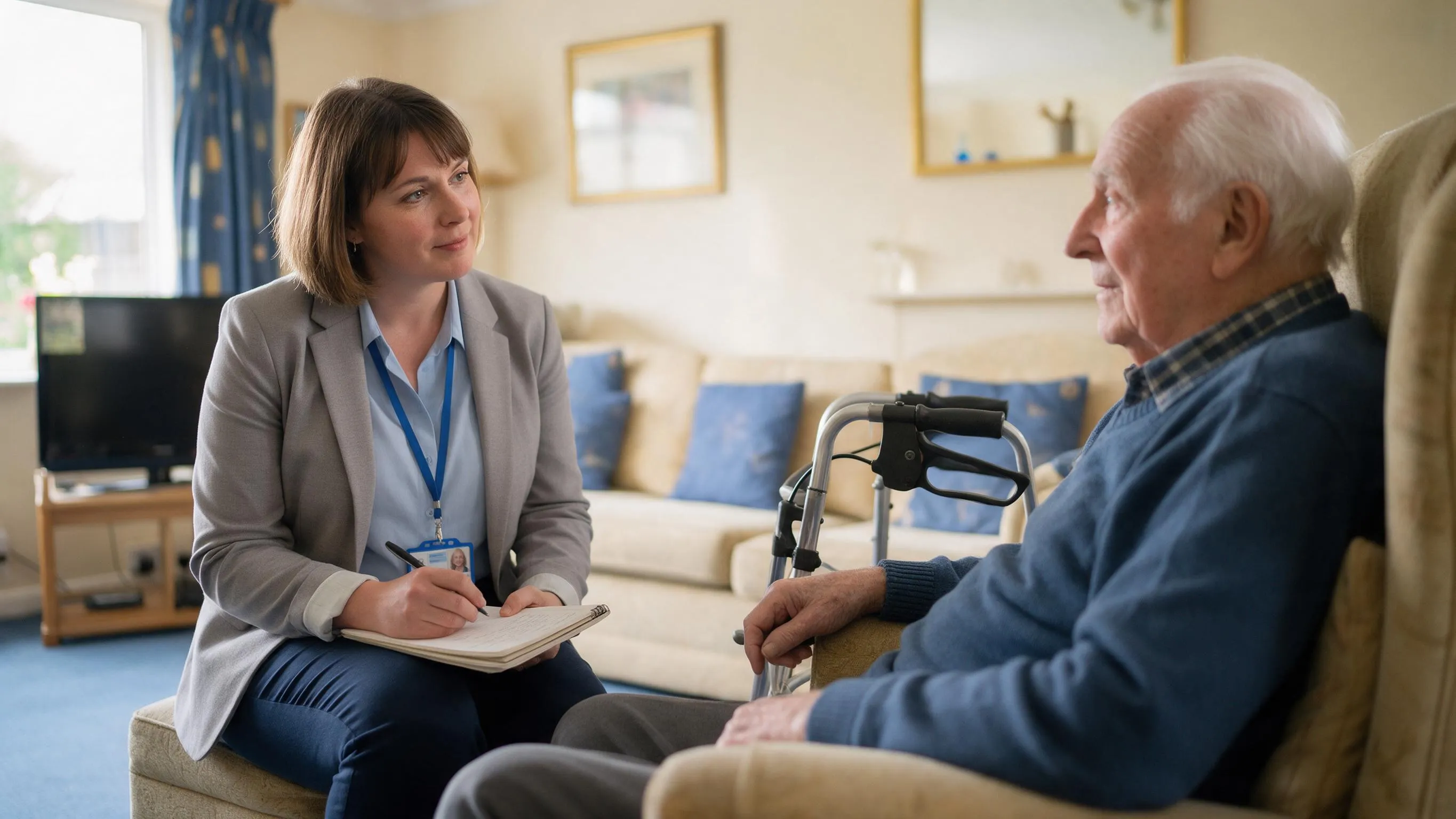
National rules set a minimum threshold. A person’s needs are eligible when all three of these apply:
- The needs arise from a physical or mental impairment or illness.
- Because of those needs, the person is unable to achieve two or more of the outcomes in the regulations.
- As a result, there is, or is likely to be, a significant impact on their wellbeing.
The outcomes include managing nutrition, personal hygiene, toilet needs, being appropriately dressed, using the home safely, keeping the home habitable, keeping up relationships, taking part in work, learning or volunteering, using local facilities and transport, and caring for a child.
“Unable” does not only mean cannot do it at all. It also counts when someone can only manage with help, when doing it causes significant pain, distress or anxiety, when it puts them or others at risk, or when it takes much longer than normal.
The council must give the person a copy of its decision. If needs are not eligible, it must still give advice and information about other help in the community.
The financial assessment
If the needs are eligible and the council will meet them, it carries out a financial assessment to decide what the person pays. In England in 2026/27, people with savings and capital over £23,250 usually pay for their own care. Below that, the council contributes, and the person pays what they can afford from their income, plus a contribution from their capital if it is between £14,250 and £23,250. For care at home, the value of the person’s home is not counted. The council must give a written record of the financial assessment. See council funding for care.
The council’s care and support plan
Where the council meets eligible needs, it agrees a care and support plan with the person, sets a personal budget (the cost of meeting the needs) and offers the option of direct payments so the person can arrange their own care. The person must be given a copy of the final plan, and anyone else they choose can have one too.
The care provider’s assessment
Before care starts, a CQC-registered provider must assess the person’s needs and preferences together with them, or with someone lawfully acting on their behalf. CQC expects the assessment to cover the whole person: health, personal care, emotional, social, cultural, religious and spiritual needs, as well as specific issues such as continence or dementia.
A good provider’s assessment usually takes place at home and covers:
- daily routine: waking, washing, meals, rest, outings and bedtime;
- health conditions, medicines and the professionals involved;
- moving and handling, and any equipment;
- nights: how often help is needed;
- communication, memory and mood;
- likes, dislikes, history, faith, culture and what makes a good day;
- for live-in care, the carer’s room and the home as a place of work.
What a good care plan contains
A person-centred care plan is written with the person, in their words where possible, and is clear and easy to follow. National guidance from NICE says it should:
- recognise what the person can and wants to do for themselves;
- address safety, wellbeing, independence and any specialist needs;
- cover practical help and social needs as well as personal care;
- set out the role of family and other carers;
- describe how success will be measured.
In practice, look for:
- About me: life history, important people, routines and preferences.
- Goals: what the person wants care to help them achieve.
- Daily support: each task, how the person likes it done and what they do themselves.
- Medicines: what support is given, who is responsible, how it is recorded and who to contact with concerns.
- Health: conditions, signs to watch for and when to get help.
- Risk plan: agreed risks and how they are managed.
- Decisions and consent: capacity, any Lasting Power of Attorney and advance wishes.
- Contacts and review date.
A daily care record should also be kept in the home, with the person offered a copy.
Risk assessments: safety without losing choice
Risk assessments help keep everyone safe, including the carer, but they should not take away what makes life worth living. NICE asks providers to balance the risk of an activity against how it benefits the person’s wellbeing, agree a risk plan with them, and reassess when circumstances change.
Common areas include falls, moving and handling, medicines, skin integrity, eating and drinking, fire safety, the home environment and lone working. A good plan might say: “Walks to the corner shop each morning with the carer; uses a stick; wears supportive shoes”, rather than “Not to go out”.
How the person stays in control
- Capacity is assumed. Under the Mental Capacity Act 2005, adults are assumed to be able to make their own decisions unless shown otherwise, and making an unwise decision does not mean someone lacks capacity.
- Consent comes first. Care should only be given with the person’s agreement, or in their best interests if they lack capacity for that decision.
- Choices are respected: who provides personal care, routines, food, clothes and how the day goes.
- Support to speak up: family, friends or an advocate can help.
- Plans can change at the person’s request.
See mental capacity and best interests and Lasting Power of Attorney.
Reviews: keeping the plan right
Needs change, so plans must too. NICE recommends that providers review a home care plan within six weeks, then at least once a year. The Care Act guidance expects the council to consider a light-touch review six to eight weeks after the plan is agreed, and a full review no later than every 12 months. Ask for a review sooner after a fall, a hospital stay, a new diagnosis, or if the care simply is not working.
Typical timescales
- Council assessment: there is no fixed national deadline, so ask when you call. Urgent needs can be met before the assessment is finished.
- Provider assessment: usually within days of asking.
- NHS Continuing Healthcare: a decision should normally be made within 28 days of a completed checklist; the Fast Track for people nearing the end of life usually puts care in place within 48 hours.
- Reviews: a first check within six to eight weeks, then at least once a year.
After the assessment: check these
- Have we received the written assessment and eligibility decision?
- Does it describe bad days and nights, not just good ones?
- Is every need we mentioned recorded, including needs met by family?
- Do we have a copy of the care and support plan, the personal budget and the financial assessment?
- Is there a date for the first review?
- Does the provider’s care plan sound like the person?
How to challenge a council decision
- Ask the council to explain its decision in writing.
- Check the assessment reflects everything, including bad days, nights and what family do; send corrections in writing.
- Make a formal complaint using the council’s procedure. You could write: “I am making a formal complaint about the assessment of [name] on [date]. The assessment does not reflect [specific needs]. I would like the council to [reassess, correct the record, reconsider eligibility] and reply in writing.”
- If you are still not satisfied with the council’s final response, or it has not replied within a reasonable time, contact the Local Government and Social Care Ombudsman on 0300 061 0614, usually within 12 months of knowing about the problem.
Free help is available from Age UK (0800 678 1602) and Independent Age (0800 319 6789).
What to do next
- Ask the council for a care needs assessment, and a carer’s assessment for any family carer.
- Keep a short diary of a typical week, including nights, to share at assessments.
- Gather medicines lists, hospital letters and any Lasting Power of Attorney documents.
- Ask providers for a home assessment and a written care plan and quote.
- Read the care plan with the person and ask for changes until it sounds like them.
- Put the first review date in the diary.
How we can help
Day and Nightcare’s initial assessment is free, and it is followed by a written quote, so you can see exactly what care is proposed and what it costs. We are registered with CQC and rated Good, and we provide fully managed live-in care anywhere in England from £1,550 a week, and home care visits, waking nights and sleep-ins across Oxfordshire, and 24-hour care with carers working in shifts anywhere in England. We work with people who fund their own care, councils (including direct payments) and NHS Continuing Healthcare. Call 01865 715780 to arrange an assessment.
Common questions
Can a care needs assessment happen while someone is in hospital?
Planning can start in hospital, but the full assessment often happens later. When a hospital patient is likely to need care and support after discharge, the hospital must let the council know so that planning can begin. Under the Discharge to Assess approach, the person usually goes home with short-term support first, and their longer-term needs are assessed once they have had time to recover, when a truer picture of their needs is possible.
Can family be there for the assessment?
Yes, if the person wants them there. A relative or friend can help explain what happens day to day and what the person finds hard. If the person would have substantial difficulty taking part and there is no suitable family member or friend to support them, the council must arrange an independent advocate. The person's own views should still come first, so assessors should speak with them directly.
What happens if the person refuses care?
An adult who has the mental capacity to decide can refuse care, even if others think it is unwise. Try to find out why: it may be worry about cost, strangers in the home or losing independence, and a different approach or a gradual start may help. If the person lacks capacity to make the decision, a decision can be made in their best interests. If there is serious risk of harm, talk to the GP or the council.
Who can see the care plan and the care records?
The person can see their own care plan and records, and can ask the provider for a copy of the information held about them. Family members can see them if the person agrees, or if they have legal authority to act, such as a Lasting Power of Attorney for health and welfare that covers the decision. Carers, nurses and others involved in the care see what they need to give safe care.
Is a care provider's assessment free?
Many care providers offer their initial assessment free of charge, but always ask before booking. A good assessment takes time, usually happens in the person's home and should end with a written care plan or proposal and a written quote showing all charges. You should never feel pressured to agree on the day. Day and Nightcare's initial assessment is free.
Sources and further information
- GOV.UK: Care and support statutory guidance (Care Act 2014)
- Legislation.gov.uk: Care Act 2014, section 9 (assessment of an adult's needs)
- NHS: Getting a needs assessment
- NHS: NHS continuing healthcare
- CQC: Regulation 9, person-centred care
- NICE: Home care, delivering personal care and practical support to older people (NG21)
- NHS: Mental Capacity Act
- GOV.UK: Hospital discharge and community support guidance
Prepared by the Day and Nightcare care team. Last updated 30 October 2026; sources last checked 30 October 2026. This guide is general information about care in England, not financial, legal or medical advice.