
How MS and MND affect daily life
Multiple sclerosis (MS) affects the brain and spinal cord. Common symptoms include extreme tiredness (fatigue), vision problems, numbness or tingling, balance problems, muscle stiffness and spasms, bladder and bowel problems, and difficulties with memory or concentration. Many people first have relapsing remitting MS, with flare-ups followed by recovery, which often becomes secondary progressive MS over time. Primary progressive MS worsens gradually from the start. MS is most common in people aged 20 to 50, and the NHS says most people live into old age, although life expectancy is a few years shorter on average. Some people need little help for many years; others need a lot.
Motor neurone disease (MND) affects the nerves that control muscles. It usually starts with weakness in the hands, legs or feet, or with speech and swallowing, and gradually spreads. Over time people may need a wheelchair, help with every aspect of personal care, a feeding tube, breathing support at night and a communication aid. Some people also have changes in mood, thinking or behaviour. The NHS describes MND as usually life-shortening, and it most often begins after the age of 50.
Because MND can change quickly, the most important principle is to plan one step ahead. With MS, the challenge is often unpredictability: care needs to flex with good and bad days.
Much of this guide also applies to other progressive neurological conditions. See our guide to Parkinson’s care at home.
The specialist team and how to reach it
For MS, NICE recommends that everyone has a single point of contact who knows MS services, usually an MS specialist nurse, and a comprehensive review of their care at least once a year. The wider team includes a neurologist, physiotherapist, occupational therapist, and as needed a speech and language therapist, continence specialist, dietitian and psychologist.
For MND, NICE recommends care from a specialist multidisciplinary team, with coordinated assessments at the team’s clinic usually every two to three months. The MND Association has developed MND care centres and networks across England, Wales and Northern Ireland, including one in Oxford. Not everyone attends one, as many hospitals provide good MND services.
How to get the team in place:
- Ask the neurologist or GP who the specialist nurse is, and get a direct phone number and email.
- Ask for referrals to physiotherapy, occupational therapy, speech and language therapy and a dietitian.
- Ask for a council care needs assessment, and a carer’s assessment for the main family carer.
- For MND, ask early about the palliative care team: it supports quality of life, not just the last days.
- Ask what to do out of hours or in an emergency, including if equipment fails. NICE says people with MND should be given this information.
Planning ahead
Talking about the future early, while the person can make and communicate their own decisions, protects their choices.
- Lasting Powers of Attorney for health and welfare and for property and finance. See our Lasting Power of Attorney guide.
- An advance statement of wishes, and if wanted an advance decision to refuse treatment. See advance care planning.
- For MND, NICE recommends discussing preferences for end-of-life care at diagnosis, if breathing changes significantly, and when a feeding tube (gastrostomy) or breathing support (non-invasive ventilation) is planned. Feeding tubes are best discussed early, as later placement carries more risk.
- Voice banking: the MND Association suggests early conversations with a speech and language therapist about recording the person’s voice so a communication aid can sound like them.
Equipment and adaptations
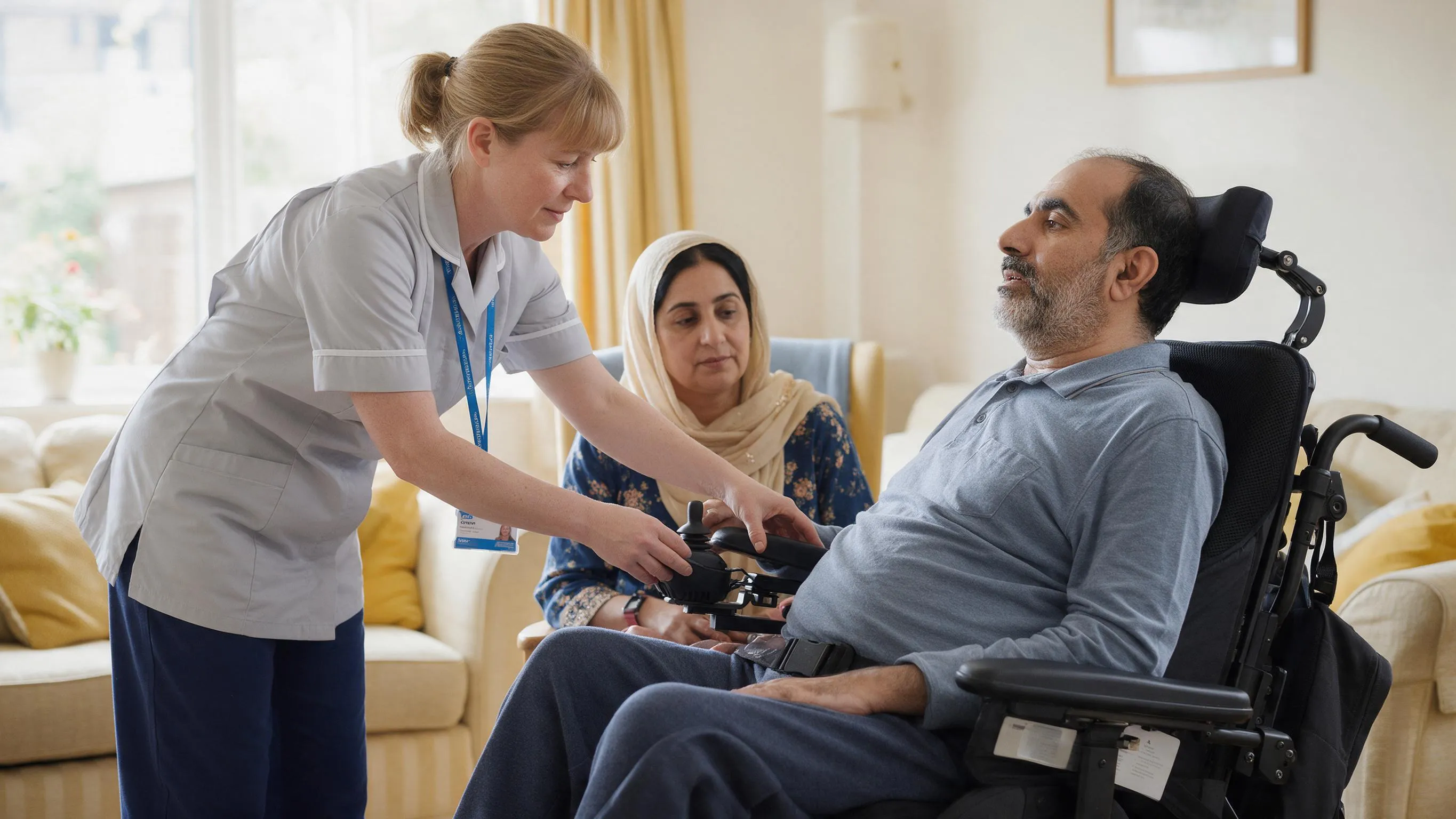
NICE says people with MND should get equipment, adaptations and wheelchairs without delay, because needs can change quickly. Equipment that is commonly needed includes:
- walking aids, then manual and powered wheelchairs from the NHS wheelchair service
- a profiling bed, pressure-relieving mattress and cushion
- a riser-recliner chair, shower chair, commode and grab rails
- a hoist and slings, with training in how to use them
- communication aids, environmental controls and adapted phones or tablets
- for MND, a suction machine and breathing equipment if prescribed
Equipment and minor adaptations costing £1,000 or less are free from the council if an assessment shows they are needed. Larger works, such as a level-access shower or a through-floor lift, may be funded by a means-tested Disabled Facilities Grant of up to £30,000 in England. Start with an occupational therapy assessment. See equipment and home adaptations and pressure ulcer prevention.
If any equipment needs electricity, join the Priority Services Register with your energy supplier and electricity network operator.
Care at home as needs grow
Care usually builds in steps: a few visits a week, then daily home care, then live-in care when help is needed throughout the day, with night care added if nights are busy.
Live-in care suits many people with MS or MND because one consistent carer learns exactly how they like to be moved, positioned, fed and helped to communicate, which matters greatly when speech becomes difficult. It also keeps the family together at home, and it can flex around MS fatigue and relapses.
Be honest about the limits:
- If every transfer needs two people, a second carer will be needed at those times.
- If help is needed most nights, for example turning or breathing support, a waking night carer is needed as well as the live-in carer.
- A hospice or nursing home may suit better if symptoms become very hard to manage at home.
MS: relapses and when to get help

NICE describes a relapse as new symptoms, or old symptoms getting worse, lasting more than 24 hours, after at least a month of being stable, when there is no infection or other cause.
- Contact the MS nurse promptly if you think a relapse has started. NICE says relapses that affect the person’s ability to do their usual tasks should be assessed and treatment offered as early as possible, and within 14 days.
- Infections, especially urine and chest infections, can make MS symptoms worse, so the team will check for them first.
- Heat, stress and illness can bring on MS fatigue.
- A relapse is a good moment to ask for extra care: NICE says social care needs should be checked and the person referred for assessment if needed.
MND: breathing, swallowing and urgent help
NICE lists signs that breathing muscles may be weakening, including breathlessness, breathlessness when lying flat, a weak cough, repeated chest infections, disturbed or unrefreshing sleep, daytime sleepiness and morning headaches. Tell the MND team promptly about any of these, and about coughing or choking when eating or drinking, or weight loss.
Call 999 if someone is struggling to breathe or is choking and it does not clear. Keep a copy of any emergency plan, advance decision and DNACPR form where ambulance crews will see it.
Help with costs
- Personal Independence Payment (PIP) for people under State Pension age: daily living £76.70 or £114.60 a week, and mobility £30.30 or £80.00 a week. It is not means-tested. See our PIP guide.
- Special rules for end of life: if a doctor or nurse has said the person might have 12 months or less to live, call the PIP claims line on 0800 917 2222 (Monday to Friday, 9am to 5pm) and ask to make a special rules claim. Ask the healthcare professional for form SR1. The higher daily living rate is paid and there is no face-to-face assessment.
- Attendance Allowance for people who first claim after State Pension age. See our Attendance Allowance guide.
- Council funding after a care needs assessment and a financial assessment.
- NHS Continuing Healthcare, including Fast Track for rapidly deteriorating conditions.
- Carer’s Allowance for a family member caring for 35 hours a week or more. See Carer’s Allowance.
- MND Association Support Funds: cost of living, everyday living, technology and innovation, and wellbeing funds. Some must be applied for by a health or social care professional.
- MS Society: some local groups offer grants, and the charity runs a legal advice service.
Where to get support
- MS Society MS Help: 0808 800 8000 (free). Monday to Friday, 9am to 5pm, except bank holidays. Email helphub@mssociety.org.uk.
- MS Trust Helpline: 0800 032 38 39 (free). Weekdays 10am to 4pm, except bank holidays. Email helpline@mstrust.org.uk.
- MND Association, MND Connect: 0808 802 6262. Monday to Friday, 9am to 4pm. Email mndconnect@mndassociation.org.
- Carers UK Helpline: 0808 808 7777. Monday to Friday, 9am to 6pm.
- Samaritans: 116 123 (free), 24 hours a day.
What to do next
- Get the specialist nurse’s direct number, and ask what to do out of hours.
- Ask for occupational therapy and equipment assessments now, ahead of need.
- Make Lasting Powers of Attorney and talk about future wishes.
- Claim PIP or Attendance Allowance, using the special rules if they apply.
- Ask the council for a care needs assessment and a carer’s assessment.
- Ask whether an NHS Continuing Healthcare Checklist should be completed.
How we can help
Day and Nightcare provides fully managed live-in care anywhere in England, from £1,550 a week, and home care visits, waking nights and sleep-ins across Oxfordshire, and 24-hour care with carers working in shifts anywhere in England. We work with private, council, direct payment and NHS Continuing Healthcare funding. If you would like to talk about care at home for someone with MS or MND, call us on 01865 715780 to arrange a free assessment and a written quote.
Common questions
Is someone with MS or MND protected at work?
Yes. GOV.UK says people with multiple sclerosis automatically meet the definition of disability under the Equality Act 2010 from the day they are diagnosed. People with other progressive conditions, such as MND, can also be classed as disabled, assessed in the usual way. Employers must then make reasonable adjustments, such as changed hours or equipment, and must not treat the person unfairly because of their condition. Family carers can ask their own employer about flexible working.
Can someone with MND be cared for at home until the end of life?
Many people can, if that is what they want. It needs a specialist team, equipment arranged early, palliative care support, a clear plan for emergencies and enough care at home, often including nights. NHS Continuing Healthcare, including the Fast Track route for someone whose condition is deteriorating rapidly, can pay for care at home. A hospice or nursing home may suit better if symptoms become hard to manage at home, and that is a valid choice too.
Does NHS Continuing Healthcare pay for care for MS or MND?
It can, but not because of the diagnosis. Eligibility depends on whether the person's needs are mainly health needs, judged on how complex, intense and unpredictable they are. People in the later stages of MND often have complex needs, such as breathing support, swallowing problems and a high risk of choking, which may qualify. People with advanced MS may qualify too. Ask the GP, specialist nurse or social worker for a Checklist assessment.
Can a live-in carer help with tube feeding or breathing equipment?
Sometimes. Some health tasks, such as feeding through a gastrostomy tube, can be delegated by an NHS nurse to a care worker who has been trained and checked as competent, with the nurse keeping clinical responsibility. This is agreed for each person and each task. Other tasks remain with nurses. Ask the specialist team and any care provider exactly which tasks would be delegated, who trains the carers and who to call if something goes wrong.
Do people with MS or MND have to tell the DVLA?
Yes, in most cases. GOV.UK says you must tell the DVLA if you have motor neurone disease. For MS, car and motorcycle drivers must tell the DVLA if the condition will affect their driving; bus, coach and lorry drivers must always tell the DVLA. You can report online or on form CN1. You can be fined up to £1,000 for not telling the DVLA about a condition that affects driving.
Sources and further information
- NHS: Multiple sclerosis
- NHS: Motor neurone disease
- NICE: Multiple sclerosis in adults, management (NG220)
- NICE: Motor neurone disease, assessment and management (NG42)
- MS Society: MS Help
- MND Association: MND Connect helpline
- MND Association: Care centres and networks
- GOV.UK: Claiming PIP if you're nearing the end of life
Prepared by the Day and Nightcare care team. Last updated 30 October 2026; sources last checked 30 October 2026. This guide is general information about care in England, not financial, legal or medical advice.