
Start with an occupational therapy assessment
An occupational therapist (OT) looks at what the person wants to be able to do, such as wash, cook, get upstairs or get in and out of bed, and finds the safest way to make it possible. That might be a piece of equipment, a change to the home, a different way of doing things, or care and support.
There are several ways to get an assessment:
- The council: ask adult social care for a needs assessment and say that equipment or adaptations may be needed.
- In hospital: ask the ward OT before discharge, so equipment is in place on the day.
- The NHS: a GP, district nurse or community physiotherapist can request equipment for health needs.
- Online: some councils offer a self-assessment for simple items, and Adapt My Home, run by Foundations, has a guided self-assessment.
Waits for an OT can be long. If the person is at risk, for example struggling to use the toilet or stairs safely, say so clearly and ask for the assessment to be prioritised. While waiting, the council still has a duty to meet eligible needs in other ways, such as help with washing.
How to get free equipment: step by step
- Contact adult social care at the council where the person lives, by phone, online form or email. In Oxfordshire, the social and health care team is on 01865 519800 (Monday to Thursday 8.30am to 5pm, Friday 8.30am to 4pm).
- Describe the difficulty, not the gadget. For example, “She can no longer get out of the bath safely” rather than “she needs a bath lift”. The OT may find a better solution.
- Mention any risk, such as recent falls, so the request is prioritised.
- Have ready: the person’s name, address, date of birth, NHS number and GP, a short description of what they find hard, and any recent falls or hospital stays.
- At the assessment, show the OT how the person manages in real life, including on the stairs, in the bathroom and getting in and out of bed.
- Delivery: equipment is usually delivered and fitted by the community equipment service. Ask for a demonstration and keep the service’s phone number for repairs and collection.
Example request
Dear Adult Social Care team,
I am writing on behalf of [name], date of birth [date], of [address], with their agreement. They are finding it increasingly difficult to [get in and out of the bath / climb the stairs / get up from the toilet], and fell on [date].
Please arrange an occupational therapy assessment for equipment and minor adaptations. I understand that aids and minor adaptations costing £1,000 or less are provided free of charge where a need is identified.
Please let me know the expected waiting time. I can be contacted on [phone or email].
Yours faithfully, [Your name and relationship]
Free equipment from the council and the NHS
Councils and the NHS jointly run community equipment services. Items are lent free for as long as they are needed and collected when they are not. Common examples include:
- Raised toilet seats, toilet frames and commodes.
- Bath boards, bath lifts and shower chairs.
- Walking frames and perching stools.
- Chair and bed raisers, bed levers and rails.
- Pressure-relieving cushions and mattresses.
- Hospital-style profiling beds and hoists, after assessment.
By law, councils in England cannot charge for aids, or for minor adaptations costing £1,000 or less, when they provide them to meet or prevent needs. Minor adaptations include grab rails, short ramps, extra stair rails, outside lighting and door-entry systems.
Some councils give a “prescription” for simple items, which you take to an accredited shop. You own the item, and you can pay the difference for a more expensive version that still meets the need.
The NHS wheelchair service lends wheelchairs after assessment, and may offer a personal wheelchair budget. For short-term needs, such as a visit from a relative, the British Red Cross and some local Age UKs lend wheelchairs.
Major adaptations: the Disabled Facilities Grant
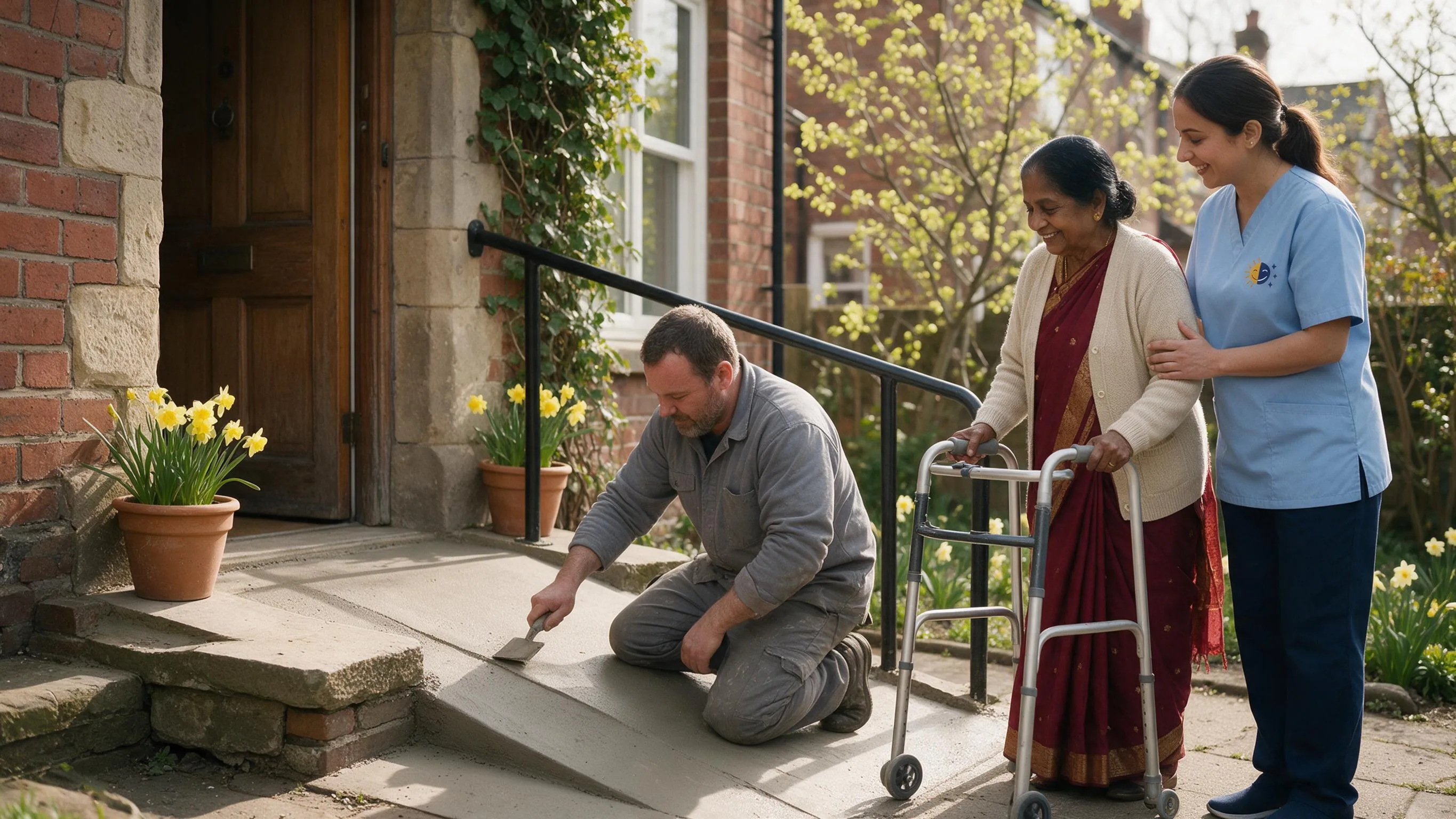
A Disabled Facilities Grant (DFG) from the council helps pay for bigger changes that let a disabled person live safely and independently at home, such as:
- Widening doors and installing ramps.
- A stairlift or through-floor lift.
- A level-access shower or wet room.
- An accessible kitchen, or adapted heating and lighting controls.
- Improved access to the garden.
- In some cases, an extension, such as a downstairs bedroom or bathroom.
How much and who qualifies
- Maximum in England: £30,000 for each grant. Councils can use discretionary powers to add more. In Scotland, Wales and Northern Ireland the rules differ.
- Who can apply: owners, tenants, and landlords on behalf of a disabled tenant. The disabled person must intend to live there for the grant period, usually five years.
- The council must agree that the work is necessary and appropriate, and reasonable and practicable for the property.
The means test
For adults, the grant is means-tested on the income and savings of the disabled person and their partner. Adult children’s income is not counted. The first £6,000 of savings is ignored. People who receive the guarantee part of Pension Credit, Housing Benefit or Universal Credit do not normally have to contribute. Disabled children can get a grant without their parents’ income being counted. A grant does not affect any benefits.
How to apply: step by step
- Ask the council for an OT assessment and say you may need a Disabled Facilities Grant. The OT recommends the work needed.
- Contact your local home improvement agency, sometimes called Care and Repair or Staying Put. These not-for-profit agencies help with forms, plans and finding reputable builders. Foundations, the government-funded national body for them, has a postcode search at findmyhia.org.uk.
- Gather your documents (see the list below).
- Get plans and quotes if the council asks for them, and apply separately for any planning permission or building regulations approval.
- Submit the full application to the council’s housing or grants team.
- Wait for written approval. The council must decide within six months of a full application. The decision must set out the work covered and the amount. Do not start work before approval, or you may get no grant.
- Have the work done, normally within 12 months of approval.
- Payment goes to you or straight to the contractor, in stages or once the work is finished and you are satisfied with it.
Documents to have ready
Councils’ forms vary, but you are likely to be asked for:
- Proof of identity and address for the disabled person, and their partner if they have one.
- Proof of ownership, or a tenancy agreement and the landlord’s written consent.
- Evidence of benefits received, such as a Pension Credit, Housing Benefit or Universal Credit award letter.
- Recent bank statements, payslips and pension statements, and details of savings, for the means test.
- The OT’s recommendations, and any plans or quotes.
Typical timescales
- OT assessment: depends on local waiting lists, from days if urgent to several months.
- Council decision: no later than six months after a full application.
- Payment: the council can delay payment, but by no more than 12 months from the date of the application.
- Completion: normally within 12 months of approval.
Points to know
- Discretionary help: councils can use their own housing assistance policies to top up a grant for expensive work, help when someone cannot afford their contribution, fund small or urgent adaptations more quickly, or help someone move to a more suitable home. Ask for the council’s policy.
- Repayment: if the grant is over £5,000, an owner-occupier may have to repay up to £10,000 if they sell within ten years. The council should consider individual circumstances.
- Challenges: if you are refused or kept waiting too long, use the council’s complaints procedure, then the Local Government and Social Care Ombudsman on 0300 061 0614.
Beds, hoists and stairlifts

Beds and mattresses
A profiling bed, which raises and lowers and helps with sitting up, makes care safer and more comfortable. These are usually lent free after a district nurse or OT assessment, often with a pressure-relieving mattress if there is a risk of pressure damage.
Hoists
Hoists help when someone cannot stand to move, for example from bed to chair. The OT will assess the right hoist and sling, and everyone using it needs training. Hoists and slings must be checked and serviced regularly; ones lent by the equipment service are maintained by that service. The moving and handling risk assessment decides whether one or two people are needed for each transfer, which affects how care is arranged, including live-in care.
Stairlifts
Ask an OT first. A stairlift is not always the best option, for example if someone has difficulty transferring on and off the seat, or if living downstairs would work better. If a stairlift is right, it may be funded through a DFG. If you buy one yourself:
- Get at least three written quotes, including servicing and repairs.
- Ask about reconditioned models, rental and buy-back schemes.
- Check what happens if it breaks down, and how quickly someone will come.
- Curved stairlifts are made to measure, so cancellation rights can be more limited. Read the terms before signing.
VAT relief on equipment and adaptations
People who are disabled or have a long-term illness do not pay VAT on equipment designed or adapted for their disability, such as adjustable beds, stairlifts, wheelchairs and alarms, or on servicing and repairs. Some building work, such as ramps, widening doors or installing a lift or accessible toilet, also qualifies. You must confirm in writing that you meet the conditions; the supplier usually provides a form.
Being older is not enough on its own. However, people aged 60 or over can pay a reduced 5% VAT rate on certain mobility aids when they are supplied and installed, including grab rails, ramps, stairlifts, bath lifts, built-in shower seats and walk-in baths with sealable doors.
To claim, ask the supplier for its VAT relief declaration before you order, and sign it, or have a GP or other responsible person sign for the person if they cannot. The supplier must be VAT-registered. If you were charged VAT wrongly, ask the supplier for a refund.
Buying equipment safely
- Get professional advice before buying anything large or expensive.
- Try before you buy, at an independent living centre or with a home trial.
- Check it fits the space, the person and the carer, including storage.
- Ask about warranties, servicing, spare parts and returns.
- Be wary of high-pressure sales, especially at home. For contracts signed at home you usually have 14 days to cancel, but made-to-measure items can be different.
- Charity-run sites such as Living Made Easy explain the options impartially.
Common mistakes to avoid
- Buying equipment before an assessment, and missing out on free provision.
- Starting building work before a grant is approved.
- Choosing equipment for how things are now, when the condition is likely to change.
- Not training everyone who will use a hoist or other moving equipment.
Helplines
- Age UK Advice Line: 0800 678 1602 (free), for information on equipment, adaptations and grants.
- Independent Age: 0800 319 6789 (free), Monday to Friday, 8.30am to 5.30pm.
- Local Government and Social Care Ombudsman: 0300 061 0614, if a council complaint has not resolved a delay or refusal.
What to do next
- Ask the council’s adult social care team for an occupational therapy assessment, using the example request above.
- If the person is in hospital, ask about equipment before discharge.
- For bigger changes, ask about a Disabled Facilities Grant and contact the local home improvement agency.
- Claim VAT relief when buying equipment, if the person qualifies.
- Check our home safety checklist for smaller changes you can make now.
How we can help
If you are planning live-in care, equipment and a suitable bedroom for the carer are worth arranging early; our guide to preparing your home for a live-in carer explains what helps. Day and Nightcare is a CQC-registered provider, rated Good, offering fully managed live-in care anywhere in England and home care across Oxfordshire. Call 01865 715780 for a free initial assessment.
Common questions
Is equipment from the council free?
Usually, yes. If a council assessment finds that someone needs equipment to help with daily living, or a minor adaptation costing £1,000 or less, such as grab rails or a short ramp, the council cannot charge for it. Equipment is normally lent for as long as it is needed and collected when it is not. Larger adaptations are usually funded through a Disabled Facilities Grant instead, which is means-tested.
How long does a Disabled Facilities Grant take?
The council must give a decision within six months of receiving a full application, and the work should usually be finished within 12 months of approval. In practice the wait for an occupational therapy assessment can add time, so apply as soon as you know changes are needed. If you have not had a decision within six months, use the council's complaints procedure and then the Local Government and Social Care Ombudsman.
Can I get a Disabled Facilities Grant if I rent my home?
Yes. Owners, private tenants, council and housing association tenants can apply, and landlords can apply on behalf of a disabled tenant. You will need your landlord's permission for the work. The disabled person must intend to live in the property for the grant period, which is usually five years. Social landlords sometimes fund adaptations themselves, so ask them first.
Do I have to pay VAT on a stairlift?
Not if the stairlift is for a disabled person or someone with a long-term illness. Equipment designed or adapted for a disability, including stairlifts, is free of VAT, and so is the cost of installing it. You must confirm in writing that you qualify, usually on a form from the supplier. People aged 60 or over who are not disabled can get a reduced 5% VAT rate on certain installed mobility aids, including stairlifts.
Can we buy equipment ourselves instead of waiting?
You can, and for simple items it is often quicker. But get advice first, ideally from an occupational therapist, because equipment that is the wrong height, size or type can make things harder or less safe. If you buy something you would have been given free, you will not usually get the money back. Never start building work before a Disabled Facilities Grant is approved, or you may lose the grant.
Sources and further information
- legislation.gov.uk: Care and Support (Charging and Assessment of Resources) Regulations 2014, regulation 3
- GOV.UK: Disabled Facilities Grants, what you'll get
- GOV.UK: Disabled Facilities Grants, how to apply
- GOV.UK: VAT relief for disabled people
- Age UK: Factsheet 42, Disability equipment and home adaptations (March 2026)
- Foundations: national body for home improvement agencies and Disabled Facilities Grants
- GOV.UK: Care and support statutory guidance
Prepared by the Day and Nightcare care team. Last updated 30 October 2026; sources last checked 30 October 2026. This guide is general information about care in England, not financial, legal or medical advice.