
Who can get PIP
PIP is for people aged 16 or over with a long-term physical or mental health condition or disability who have not yet reached State Pension age when they first claim. State Pension age is 66, rising gradually to 67 between 2026 and 2028 for people born on or after 6 April 1960. People already over State Pension age claim Attendance Allowance instead.
The person must have difficulty with daily living tasks, getting around, or both, and it must be long term: usually it will have lasted at least three months and be expected to last at least another nine. They must normally live in England or Wales and have lived in Great Britain for at least two of the last three years, with some exceptions.
PIP is often the key benefit for younger adults who need care at home, for example people living with early-onset dementia, multiple sclerosis, motor neurone disease, Parkinson’s, the effects of a stroke or brain injury, cancer, a learning disability or severe mental illness. It depends on how the condition affects the person, not on the diagnosis. Income, savings and work make no difference, and PIP is tax-free.
In Scotland, Adult Disability Payment has replaced PIP, and Northern Ireland runs its own scheme. Children under 16 get Disability Living Allowance (DLA), and adults born on or before 8 April 1948 who already get DLA keep it.
PIP rates for 2026/27
| Part | Standard rate | Enhanced rate |
|---|---|---|
| Daily living | £76.70 a week | £114.60 a week |
| Mobility | £30.30 a week | £80.00 a week |
Someone on the enhanced rate of both parts receives £194.60 a week, a little over £10,100 a year. PIP is usually paid every four weeks.
How the PIP points system works
PIP looks at 12 activities. Each has a set of statements (descriptors) worth different points, and the decision maker picks the one that best fits.
- Daily living (ten activities): preparing food; eating and drinking; managing medicines, treatments or monitoring a health condition; washing and bathing; managing toilet needs or incontinence; dressing and undressing; communicating; reading and understanding signs and written information; mixing with other people; and making budgeting decisions.
- Mobility (two activities): planning and following journeys; and moving around.
For each part, 8 to 11 points gives the standard rate and 12 points or more the enhanced rate. Two rules make a big difference:
- Reliability. A person only counts as able to do an activity if they can do it safely, to an acceptable standard, as often as they need to, and within a reasonable time, which the law sets at no more than twice as long as someone without the condition would take.
- The majority of days. A descriptor applies if it fits on more than half of the days. For conditions that come and go, such as MS or Parkinson’s, describe the pattern over several weeks, not a good day.
Needing an aid (such as a perching stool or a raised toilet seat), prompting or supervision can all score points.
How to claim PIP, step by step
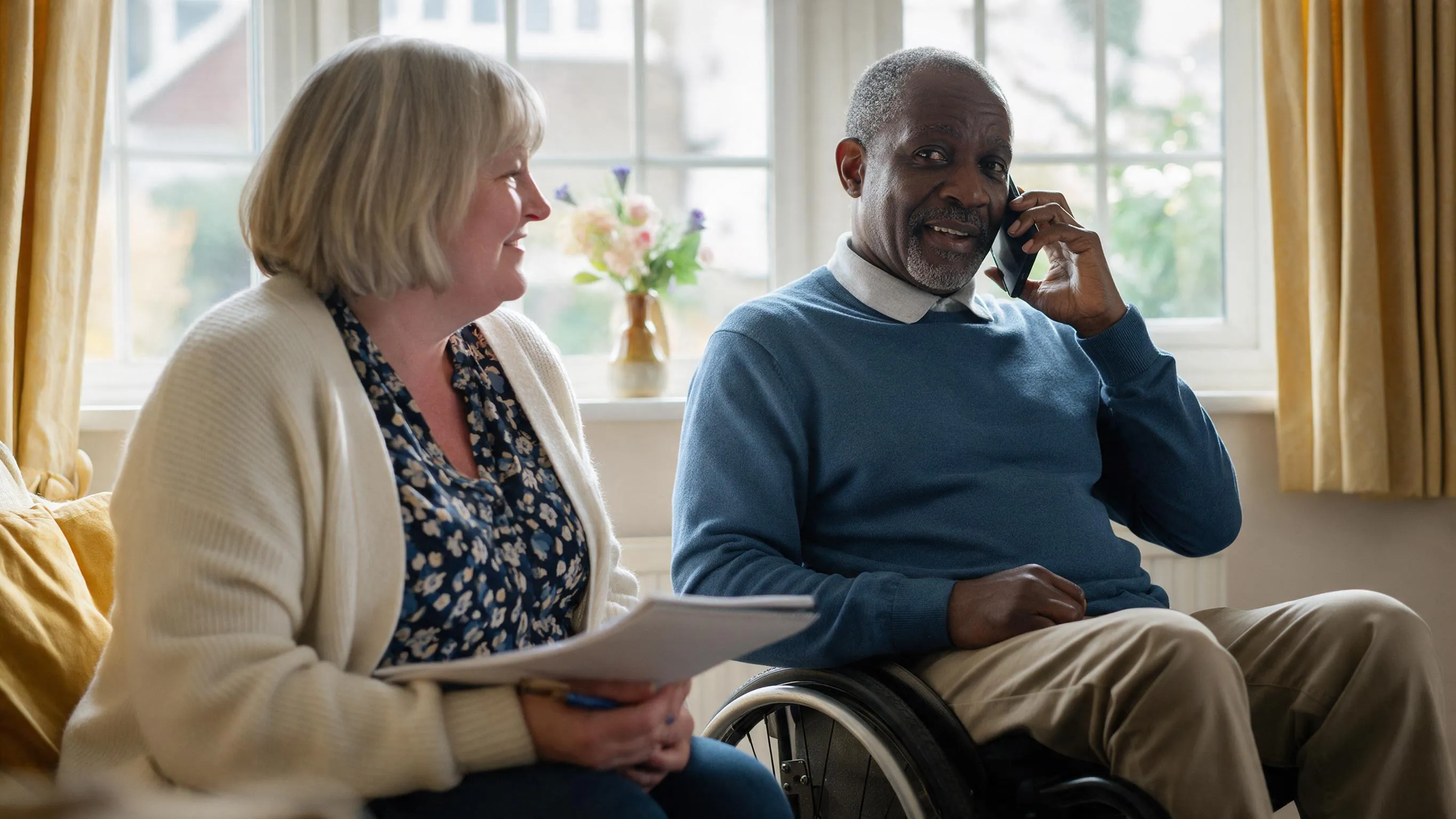
- Start the claim by phone. Call the PIP new claims line on 0800 917 2222 (Monday to Friday, 8am to 5pm; Relay UK: 18001 then 0800 917 2222). Someone else can call for you, but you need to be with them, or you can ask for them to be added to the call. You can also start a claim by writing to Freepost DWP PIP 1 with your name, address and a note saying you want to claim PIP, and in some areas you can apply fully online. The claim usually starts on the day you make contact.
- Fill in the “How your disability affects you” form. It usually arrives by post within two weeks and must be returned, or completed online, within one month. If you need more time, call the PIP enquiry line on 0800 121 4433 (Monday to Friday, 9am to 5pm; Relay UK: 18001 then 0800 121 4433) before the deadline.
- Attend the assessment, if one is needed. A health professional goes through each activity at an assessment centre, at home, by phone or by video call; it usually takes about an hour. Take someone with you, and ask for a home assessment if travelling would be hard.
- Receive the decision. A DWP decision maker decides, and the letter says what you will get, the first payment date and when the award will be reviewed. A first award lasts between nine months and ten years.
How long it takes: in July 2026, new claims took an average of 18 weeks from start to decision.
What to say when you call:
“Hello, I’d like to start a new claim for Personal Independence Payment. My son [name] is with me and is helping me today. I have my National Insurance number, bank details and my GP’s details ready.”
Have ready: contact details, date of birth, National Insurance number, bank or building society details, your GP’s or health worker’s name, address and phone number, and dates and addresses of any hospital or care home stays and of any time abroad for more than four weeks.
How to describe difficulties: example wording
Go through every activity, describe bad days as well as typical ones, and say why something cannot be done reliably. Be honest and never exaggerate. These examples show the detail that helps:
Preparing food: “I cannot stand for more than five minutes because of pain and fatigue from MS. I drop pans because my grip is weak, and I have burnt myself twice this year. On most days I can only manage a microwave meal, and only if someone is there.”
Managing medicines: “My early-onset dementia means I forget whether I have taken my tablets. My wife sets them out in a dosette box and reminds me at each dose, four times a day. Without prompting I either miss doses or take them twice.”
Moving around: “I can walk about 30 metres with a stick before pain in my hips forces me to stop. I then need to rest for several minutes. On bad days, more than half the week, I can only walk from my bed to the bathroom.”
Planning and following journeys: “Since my stroke I become confused and anxious in unfamiliar places. I cannot follow a new route on my own, even with directions, and I have got lost twice. I need someone with me for any journey that is not routine.”
Send copies of letters from the GP, consultant, specialist nurse or occupational therapist, any care plan and a short statement from a family carer, with your full name, date of birth and National Insurance number on each page. Keep copies of everything. Free help is available from Citizens Advice and many disability charities.
Special rules for end of life
If a doctor or other healthcare professional has said the person might have 12 months or less to live, call 0800 917 2222 and say: “I’m calling to make a claim under the special rules for end of life.” Ask the healthcare professional for form SR1. The enhanced daily living rate (£114.60 a week) is paid automatically, the mobility part depends on the person’s needs, and there is no face-to-face assessment. In July 2026 these claims took an average of three working days. See planning end-of-life care at home.
PIP when someone needs care

Council-funded care. The council’s financial assessment ignores the mobility part of PIP completely. The daily living part can be counted as income, but the council must leave the person with a minimum income and allow for disability-related costs it is not meeting. See council funding for care and direct payments and personal budgets.
A family carer. If someone gets the daily living part at either rate, a relative or friend who cares for them for at least 35 hours a week may be able to claim Carer’s Allowance.
Hospital and care homes. Both parts stop after 28 days in hospital. In a care home paid for by the council or the NHS, daily living stops after 28 days but mobility continues. People who pay their own fees keep both. PIP continues as normal for people cared for at home, including with live-in care.
What PIP can unlock. Depending on the award: a Blue Badge, a vehicle tax exemption or reduction, the Motability scheme (enhanced mobility rate), a Disabled Persons Railcard, extra amounts in means-tested benefits, and a Council Tax discount for someone with a severe mental impairment.
What happens at State Pension age
- Existing PIP continues, usually as an ongoing award with a light-touch review around every ten years.
- Daily living can change up or down as needs change.
- Mobility is restricted. After State Pension age you usually cannot start getting the mobility part, or move from the standard to the enhanced rate, even if walking becomes harder.
- New claims are limited to people who had PIP within the last 12 months, generally for the same or a related condition. Otherwise the benefit to claim is Attendance Allowance, which has no mobility part.
If you are approaching State Pension age and already have daily living or mobility difficulties, claim PIP before your birthday rather than waiting.
How to challenge a decision
Ask for a mandatory reconsideration within one month of the date on the decision letter, by phoning the number on the letter or writing to the office that made the decision. Say which activities and points you disagree with and why, and send any new evidence. You then receive a mandatory reconsideration notice; if you still disagree, appeal to the independent tribunal within one month of it. Appeals are free and usually take at least six months to be heard. The whole award is looked at again, so get advice first if you already receive part of PIP. Our Attendance Allowance guide includes a letter you can adapt: list each activity, the descriptor you think applies, and the evidence that shows it.
PIP is being reviewed
The government’s Timms Review of PIP shared emerging recommendations in September 2026 and expects to publish its final report later in the autumn. Any changes would be announced on GOV.UK. This guide describes the rules in force in October 2026.
Your PIP checklist
- National Insurance number, date of birth, contact and bank details
- GP’s or health worker’s name, address and phone number
- Dates of hospital or care home stays and of time abroad
- A diary of one to two weeks covering all 12 activities, and nights
- Letters from professionals, a care plan and a carer’s statement
- Form returned within one month, with a copy kept
- Assessment date noted, with someone to come with you
- Decision letter checked against the points for each activity
What to do next
- Check the person is under State Pension age and their difficulties are expected to last at least 12 months in total.
- Call 0800 917 2222 to start the claim, asking for the special rules if they may have 12 months or less to live.
- Keep a diary and gather evidence while you wait for the form.
- Once PIP is awarded, check Carer’s Allowance for the carer, a Blue Badge and other help.
How we can help
PIP can go towards the cost of care at home, whoever provides it. Day and Nightcare is a CQC-registered home care provider, rated Good, supporting people at home since 2008. We provide home care visits from one hour, waking nights and sleep-ins across Oxfordshire, and 24-hour care with carers working in shifts anywhere in England, and fully managed live-in care anywhere in England from £1,550 a week, funded privately, by councils (including direct payments) or by NHS Continuing Healthcare. Call us on 01865 715780 to arrange a free initial assessment and a written quote.
Common questions
Can you work and get PIP?
Yes. PIP is not affected by earnings, so you can work full time or part time and still get it. It is also not affected by savings or a partner's income. What matters is how your condition affects your ability to carry out daily living and mobility activities. DWP may ask how you manage at work, so describe any adjustments or help you rely on there.
How many points do you need for PIP?
You need at least 8 points for the standard rate and at least 12 points for the enhanced rate. The two parts are scored separately: points from the ten daily living activities count towards the daily living part, and points from the two mobility activities count towards the mobility part. You can get one part without the other, or both at different rates.
What is the difference between PIP and Attendance Allowance?
Age and mobility. PIP is for people who first claim before State Pension age and has a mobility part as well as a daily living part. Attendance Allowance is for people who first claim after State Pension age, covers only personal care and supervision, and has no mobility part. The daily living rates are the same: £76.70 and £114.60 a week in 2026/27. You cannot get both at once.
Do you lose PIP when you reach State Pension age?
No. If you are getting PIP when you reach State Pension age, you keep it, and it is usually reviewed only lightly, about every ten years. The daily living part can still go up or down if your needs change. The mobility part is restricted: you usually cannot start getting it, or move from the standard to the enhanced rate, after State Pension age, even if your walking gets worse.
How long does a PIP claim take?
For new claims under the normal rules, DWP's figures for July 2026 show an average of 18 weeks from starting the claim to a decision. Claims under the special rules for end of life took an average of 3 working days. If PIP is awarded, it is paid from the date you started the claim, usually the day you phoned, as long as you returned the form in time, so a long wait does not reduce what you receive.
Can PIP be backdated?
Generally no. PIP is paid from the date you start your claim, usually the day you phone the new claims line, provided you return the 'How your disability affects you' form within the time allowed. It is not paid for any period before that. If you think you or a relative might qualify, start the claim promptly and take your time over the form.
Sources and further information
- GOV.UK: Personal Independence Payment (PIP)
- GOV.UK: Benefit and pension rates 2026 to 2027
- GOV.UK: Disability benefits helplines (PIP enquiry line)
- GOV.UK: Personal Independence Payment statistics to July 2026
- legislation.gov.uk: The Social Security (Personal Independence Payment) Regulations 2013
- Citizens Advice: Getting PIP after you've reached State Pension age
- GOV.UK: State Pension age timetable
- GOV.UK: The Timms Review co-chair update, September 2026
Prepared by the Day and Nightcare care team. Last updated 30 October 2026; sources last checked 30 October 2026. This guide is general information about care in England, not financial, legal or medical advice.