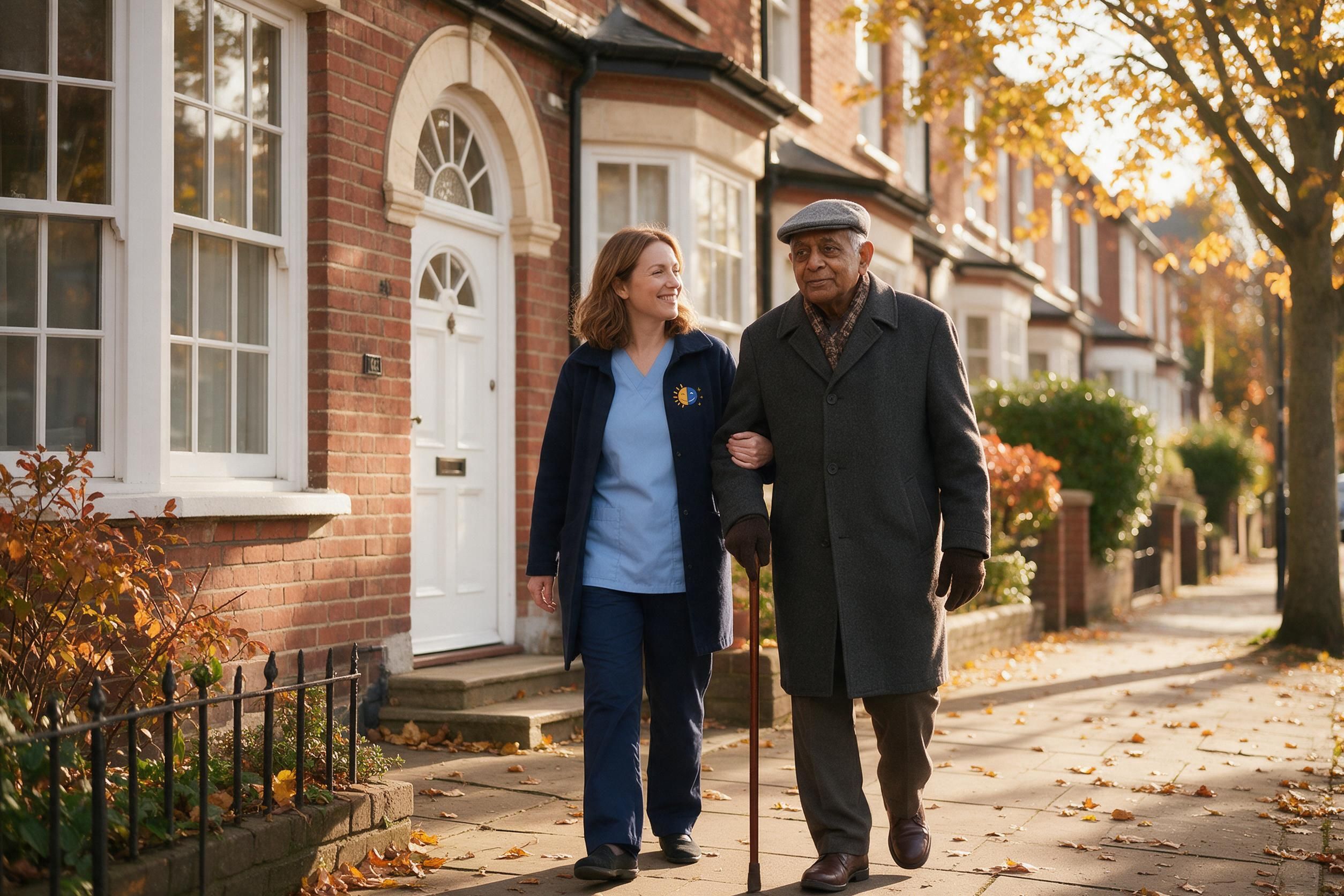
Our care, where you live
Our live-in care in Gloucester
Live-in care means one-to-one support in your own home: personal care, medication support, meals, help around the house, getting out and about, and someone close by at night. Whether it suits the person, and whether one carer can support a couple, is worked out at the free assessment. Read more in live-in care explained and how it works day to day.
How we arrange live-in care in Gloucester
Day and Nightcare provides fully managed live-in care in Gloucester and nearby, from £1,550 a week. One main carer lives in the home; a relief carer covers their holidays and time off, and a manager is on call. Care starts with a free assessment, a written quote and a written care plan.
Care can be paid for privately, by Gloucestershire County Council (including direct payments) or by NHS Continuing Healthcare. We have provided Discharge to Assess (D2A) care since 2014. If someone is in hospital, tell us the expected discharge date (see live-in care after hospital). Our care team is on 01865 715780.
Arranging care and funding in Gloucester
Gloucestershire County Council arranges adult social care. Call its Adult Social Care Helpdesk on 01452 426 868 (Monday to Friday, 8am to 5pm). In a serious social care emergency out of hours, call the Emergency Duty Team on 01452 614 194.
Read more: arranging care and funding in Gloucester
The care needs assessment is free; a financial assessment then decides whether your relative pays. With more than £23,250 in savings they would usually pay the full cost, and the home is not counted when care is at home. Funding can be taken as a direct payment. See council funding for care.
If you help a relative, the Gloucestershire Carers Hub carries out carers’ assessments on 0300 111 9000 (Monday, Wednesday and Friday 9am to 5pm; Tuesday and Thursday 8am to 8pm).
Gloucester City Council collects council tax. Ask about the severely mentally impaired discount (a free doctor’s certificate and a qualifying benefit), the carer’s discount (a carer who lives in, gives at least 35 hours a week and is not a partner) and the disabled band reduction, even in band A. Apply through My Gloucester or revenues@gloucester.gov.uk. See council tax discounts for care.
Urgent care and leaving hospital in Gloucester
- A&E: Gloucestershire Royal Hospital, Great Western Road, has the county’s 24-hour consultant-led A&E.
- GP care, seven days: the Gloucester Health Access Centre, Quayside House, Quay Street, sees patients by appointment (weekdays 8am to 8pm, Saturday 8am to 6pm, Sunday 10am to 6pm; ring 01452 336290 first). It is not an A&E.
- Minor injuries: none in the city; the units at Stroud General and Tewkesbury hospitals are usually open 8am to 8pm (last walk-in 7.30pm). Not A&Es; call NHS 111 first.
Gloucestershire Royal’s Discharge Lounge (7am to 7pm) is where patients wait to go home. The Onward Care Team plans discharges for people who will need ongoing care (0300 422 6311, weekdays 8am to 4pm; reduced weekend service). Use the trust’s going-home checklist: where your relative is going, their medicines and when to take them, heating on, food in the fridge. Patient transport needs national criteria to be met (Patient Transport Advice Centre, 01278 726968).
Home First gives NHS-funded support at home for 1 to 10 days, seven days a week, coordinated by the local Integrated Community Team; a care needs assessment may follow.
If needs are mainly health needs, ask about NHS Continuing Healthcare. NHS Gloucestershire’s team is on 01452 925197 (weekdays 9am to 5pm). A decision should usually come within 28 days, and Fast Track care is normally arranged within 48 hours.
Local help in Gloucester
Carers' services, dementia support, transport, befriending and other local help, with phone numbers.
Read more: local help in Gloucester
- Memory worries. Managing Memory Together, the NHS memory service, accepts self-referrals on 0800 694 8800 (seeing the GP first is advised). The Alzheimer’s Society’s Dementia Adviser Service (01452 525222, weekdays 9am to 5pm) supports people with a diagnosis and their carers. See live-in dementia care.
- Singing. The Gloucester Dementia Choir meets on Fridays (10.30am and 12.15pm) at Barbican House, 31 Barbican Road: free, carers welcome, and transport can be arranged (Gloucestershire Academy of Music, 01452 668592).
- Day centre. The Black Elders’ Day Centre, open to all, runs Tuesdays and Thursdays, 10am to 3.30pm, with activities, lunch and carers’ support (01452 311388).
- Advice in person. Age UK Gloucestershire sees people aged 50 and over, and their families, at the Gloucestershire Royal atrium (weekdays 11am to 1pm) and at Messenger House on Wednesdays (9.30am to 1pm); 01452 422 660.
- Getting about. Community Connexions’ door-to-door transport is for anyone who finds public transport difficult: £25 a year to register, then local trips from £7 each way (0345 680 5029).
- Equipment. The Gloucestershire Equipment Loan Service supplies equipment after a healthcare professional’s assessment (01452 520438, weekdays 8.30am to 4.30pm).
- End of life. Sue Ryder Leckhampton Court in Cheltenham is the county’s only specialist palliative care inpatient unit (01242 230 199). Its 24-hour Patient Line (0300 303 1395) is for its patients and people being referred.
What may change soon
The Government is minded to create a single unitary council for Gloucestershire, taking over in April 2029 (proposed, not confirmed). Until then, the county council arranges adult social care and Gloucester City Council collects council tax.
Useful local contacts
Useful contacts in Gloucester
The council, NHS teams, hospitals and local services you are most likely to need in Gloucester, with links to their official pages. Open any heading for the details.
Council and care assessments
Adult social care in Gloucester is arranged by Gloucestershire County Council. Anyone who appears to need care can ask for a free care needs assessment, whatever their savings. If the council funds care, you can usually take it as a direct payment and use it for live-in care from us.
- Gloucestershire County Council: ask for a care needs assessment (telephone 01452 426 868); carer's assessment.
NHS Continuing Healthcare
When someone's main need is a health need, the NHS pays for all of their care through NHS Continuing Healthcare, and it is not means-tested. For Gloucester it is arranged by NHS Gloucestershire Integrated Care Board (Continuing Healthcare information). See our NHS Continuing Healthcare guide.
Hospitals near Gloucester
If someone is in hospital, tell us the expected discharge date as early as you can, and we will work with you and the discharge team on when live-in care can start.
- Gloucestershire Royal Hospital: Great Western Road, Gloucester GL1 3NN. The county's consultant-led A&E, open 24 hours. Discharge Lounge 7am to 7pm; Onward Care Team 0300 422 6311 (weekdays 8am to 4pm, reduced weekend service) for patients who will need ongoing care (leaving hospital information)
- Sue Ryder Leckhampton Court Hospice: Church Road, Leckhampton, Cheltenham: Gloucestershire's only specialist palliative care inpatient unit; main number 01242 230 199; 24-hour Patient Line 0300 303 1395 for people receiving its care or being referred
Local support and charities
- Gloucestershire Carers Hub: Carers' support (0300 111 9000)
- Managing Memory Together (NHS memory service): Dementia support (0800 694 8800)
- Alzheimer's Society Dementia Adviser Gloucestershire: Dementia support (01452 525222)
- Barton & Tredworth Memory Cafe: Dementia support
- Black Elders' Day Centre: Day opportunities (01452 311388)
- Age UK Gloucestershire: Age UK (01452 422 660)
- Community Connexions: Community transport (0345 680 5029)
- Healthwatch Gloucestershire: Healthwatch: your independent voice on health and care (0800 652 5193)
Council tax
Council tax in Gloucester, including discounts for people with a severe mental impairment, for disabled people and for some carers, is handled by Gloucester City Council. See council tax discounts for care.
Villages around Gloucester
- Quedgeley
- Kingsway
- Hucclecote
- Abbeymead
- Barnwood
- Longlevens
- Kingsholm
- Tuffley
- Matson
- Barton and Tredworth
- Churchdown
- Innsworth
Your questions
Questions about live-in care in Gloucester
Who do I call in Gloucester to ask for a care assessment?
Call Gloucestershire County Council's Adult Social Care Helpdesk on 01452 426 868, Monday to Friday 8am to 5pm, or email socialcare.enq@gloucestershire.gov.uk. The county council, not Gloucester City Council, arranges adult social care. The helpdesk talks through your relative's needs and arranges an assessment if one is needed, and the assessment itself is free. In a serious social care emergency out of hours, call the Emergency Duty Team on 01452 614 194. A family carer can ask the Gloucestershire Carers Hub (0300 111 9000) for their own carer's assessment.
Which A&E serves Gloucester, and is it open at night?
Gloucestershire Royal Hospital on Great Western Road has the county's 24-hour consultant-led A&E. Cheltenham General's A&E is consultant-led only from 8am to 8pm, so overnight, life-threatening emergencies are treated at Gloucestershire Royal. For GP care that cannot wait, the Gloucester GP Health Access Centre at Quayside House is open seven days a week by appointment: ring 01452 336290 first. For anything else urgent, call NHS 111, which can book an appointment at a Minor Injury and Illness Unit.
How do I claim the council tax discount for someone with dementia in Gloucester?
Gloucester City Council does not count someone classed as severely mentally impaired, which can include Alzheimer's disease. You need a certificate from a registered medical practitioner, which is free, and proof of a qualifying benefit such as Attendance Allowance or the daily living part of Personal Independence Payment. Upload the form through My Gloucester, or email it to revenues@gloucester.gov.uk with your council tax account reference. If the person lives alone, the property may be exempt.
Is there dementia support in Gloucester for families whose first language is not English?
Yes. The Barton & Tredworth Memory Cafe at Charter Court, Victoria Street, meets on the second Tuesday of each month from 2pm to 4pm, and its team speaks Cantonese, Mandarin, Gujarati, Urdu, Patois, Polish and English. No referral is needed and refreshments are by donation; contact details are on its listing in the county council's Your Circle directory. Age UK Gloucestershire's Wednesday drop-in at Messenger House offers a Language Line translator service.
How much does live-in care cost in Gloucester?
Live-in care with Day and Nightcare costs from £1,550 a week in Gloucester, the same as everywhere in England, for one person with a carer who rests at night. That includes our care team's management (the assessment, care plan, reviews, supervision and the on-call manager) and the carer's food; break cover and the carer's travel are extra. For a couple it is from £1,800 a week, where one carer can safely meet both partners' needs. You receive a written quote after a free assessment.
Can the council help pay for live-in care in Gloucester?
Yes, if the person's care needs meet the national eligibility criteria and their savings are below £23,250 (2026/27). Adult social care in Gloucester is arranged by Gloucestershire County Council. Ask for a care needs assessment; if you are eligible, council funding can usually be taken as a direct payment and used for live-in care from us.
Can live-in care start when someone leaves Gloucestershire Royal Hospital?
It can. Tell us the expected discharge date as early as you can, and we will work with you and the ward's discharge team on when live-in care can start. We can often start within 24 to 48 hours of the assessment, depending on carer availability, and we confirm the start date once a carer is arranged. We have provided Discharge to Assess (D2A) care since 2014.
Sources and further information
Show the 29 official sources for this page
- Gloucestershire County Council: Adult social care contact us
- Gloucestershire County Council: How to have an assessment of your care and support needs
- Gloucestershire County Council: Prioritising your own health and wellbeing, the Carer's Assessment
- Gloucestershire Carers Hub
- Gloucester City Council: Council tax discounts
- Gloucester City Council: Severely mentally impaired
- Gloucester City Council: Carers discount
- Gloucester City Council: Disabled reduction
- Cheltenham Borough Council: Government sets out next steps for local government reorganisation in Gloucestershire
- Gloucestershire Hospitals NHS Foundation Trust: Urgent advice and care
- Gloucestershire Hospitals NHS Foundation Trust: Hospital locations and maps
- Gloucestershire Hospitals NHS Foundation Trust: Our wards and units
- Gloucestershire Hospitals NHS Foundation Trust: Onward Care Team
- Gloucestershire Hospitals NHS Foundation Trust: There's no place like home
- Gloucestershire Hospitals NHS Foundation Trust: Non-emergency hospital transport
- Gloucestershire Health and Care NHS Foundation Trust: Community hospitals
- Gloucestershire Health and Care NHS Foundation Trust: Home First
- NHS Gloucestershire: Continuing healthcare
- Gloucestershire Health and Care NHS Foundation Trust: Managing Memory Together
- Your Circle (Gloucestershire County Council): Gloucestershire Dementia Adviser Service
- Alzheimer's Society: Dementia Adviser Gloucestershire
- Your Circle: Barton & Tredworth Memory Cafe
- Your Circle: Gloucester Dementia Choir
- Gloucestershire Academy of Music: Gloucester Dementia Choir
- Your Circle: Black Elders' Day Centre
- Age UK Gloucestershire: Community Drop-Ins
- Community Connexions: Door to door transport
- Gloucestershire County Council: Gloucestershire Equipment Loan Service, how to contact us
- Sue Ryder: Leckhampton Court Hospice
Local information checked 31 October 2026. Links go to the official council, NHS and charity pages.