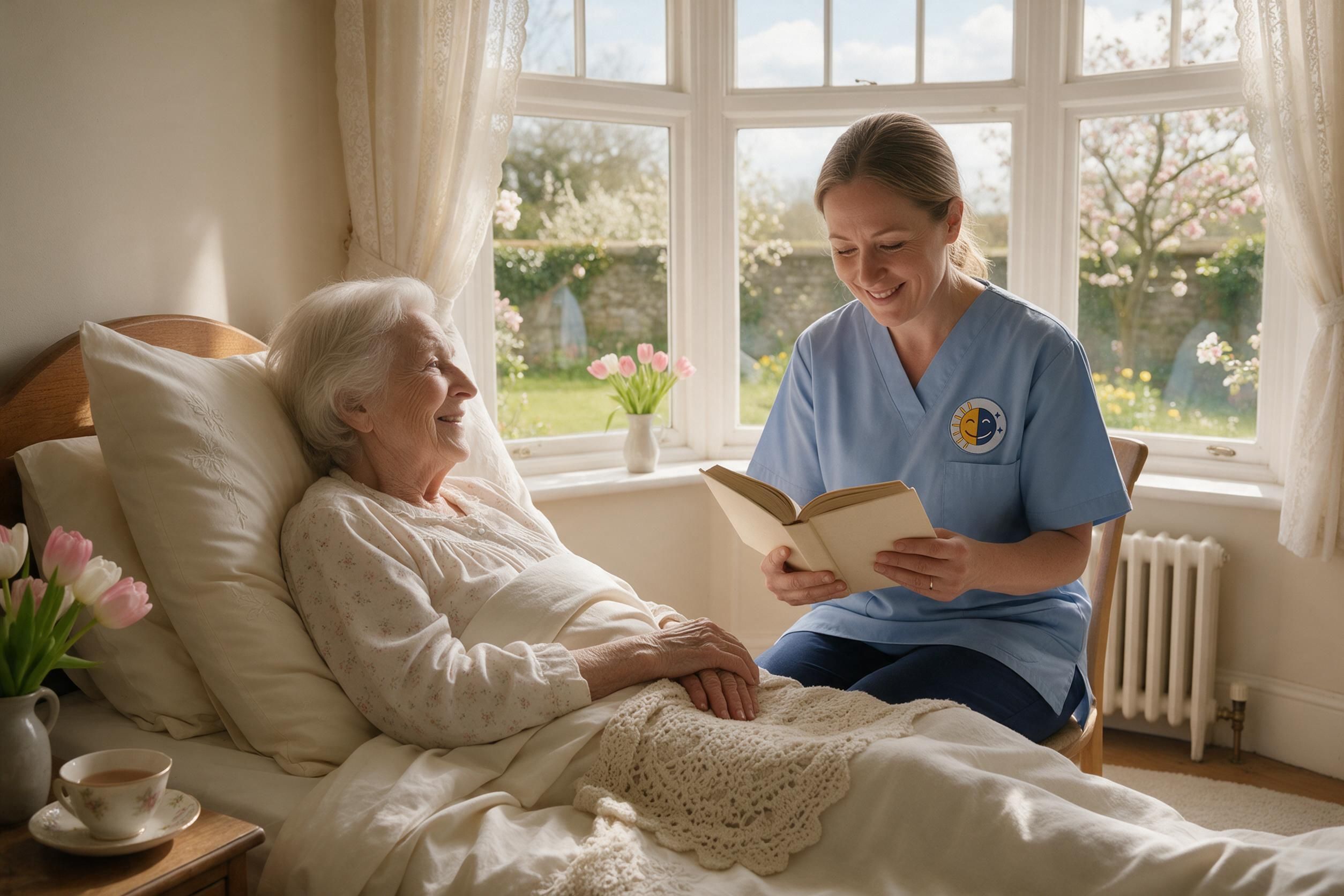
Choosing to be cared for at home
For many people, home is where they feel most themselves: their own bed, their own garden view, their family, their pets, their routines. With planning and the right team, dying at home is possible for many people, even with complex needs.
It helps to be honest about what it involves. Caring for someone at home towards the end of life can be physically and emotionally demanding, especially at night. Symptoms sometimes need specialist help. Having a plan B, such as a hospice bed if things become difficult, is sensible, not a sign of giving up. The aim is the right care in the right place, at each stage.
If the person can, ask them directly where they would like to be cared for and where they would prefer to die, and record it in an advance care plan. Tell the GP so it is on their record.
The team around you
Care at the end of life at home is shared by several people:
- The GP coordinates medical care, prescribes medicines and can complete the paperwork for funding and benefits.
- District or community nurses visit to manage symptoms, give injections, set up syringe pumps, care for skin and arrange equipment.
- Specialist palliative care teams, often based at a hospice, advise on difficult pain or other symptoms and support the family.
- Hospice at home services, in many areas, bring hospice nurses and care workers into the home, sometimes including overnight support. Hospice care is free.
- Marie Curie nurses and other charity services provide nursing care at home, including overnight, in many areas.
- Occupational therapists arrange equipment such as a hospital bed, pressure-relieving mattress and commode.
- Carers, whether visiting carers or a live-in carer, provide the day-to-day personal care and companionship.
- Out-of-hours services: make sure you know who to call at night and at weekends, usually through NHS 111 or a number given by the GP or hospice.
How live-in care helps at the end of life
A live-in carer can make a home death possible for families who could not otherwise manage. Having someone there through the day and night means:
- personal care, mouth care, gentle repositioning and comfort, at whatever hour it is needed
- someone to notice changes in pain, breathing or distress, and call the nurses promptly
- help with prescribed medicines, as set out in the care plan
- support with meals, drinks and the household, for as long as these matter
- family members can rest, and spend their time being a partner, son or daughter rather than a carer
Live-in carers work alongside district nurses and hospice teams; they do not replace them. Injections and syringe pumps remain the nurses’ role. Read more about live-in care at the end of life.
Just in case medicines
Just in case medicines, also called anticipatory medicines, are prescribed in advance so they are ready at home if distressing symptoms come on suddenly, such as pain, sickness, agitation, breathlessness or noisy breathing caused by secretions. They are usually given by injection, which is useful when someone can no longer swallow tablets.
The GP or specialist prescribes them, and they are kept at home, often in a labelled box with the equipment and a chart, out of reach of children. When symptoms arise, phone the district nurses or out-of-hours service, who will come and give them. NICE guidance on caring for dying adults covers how these medicines should be prescribed and reviewed. If symptoms continue, the nurses may set up a syringe pump to give medicines steadily over 24 hours.
NHS Continuing Healthcare Fast Track
The Fast Track is the quickest way to get the NHS to pay for care in full at the end of life. Under the national framework:
- it is for people with a rapidly deteriorating condition that may be entering a terminal phase
- an “appropriate clinician”, meaning a registered nurse or doctor involved in the person’s care (including hospice clinicians), completes the Fast Track Pathway Tool
- there must be no strict time limit based on life expectancy: “may be entering a terminal phase” is not limited to situations where death is imminent
- the integrated care board (ICB) must accept a properly completed tool and act on it immediately, and the care package should usually be in place within 48 hours
- it can fund care in the person’s own home, including live-in care where that is the right way to meet their needs, and should be used even if a care package is already in place but is being paid for privately or by the council
Funding may be reviewed later if the person’s condition improves. Read more in our NHS Continuing Healthcare guide.
Words you can use with the GP, district nurse or hospice nurse:
“[Name]’s condition is getting worse quickly and we would like to care for them at home. Please could you consider completing the NHS Continuing Healthcare Fast Track Pathway Tool, so that care can be arranged without delay? Could you also let us know who at the integrated care board will arrange the care, and when we can expect to hear?”
Other help with costs
- Benefits under the special rules. If a doctor or nurse thinks someone may have 12 months or less to live, they can complete form SR1. People over State Pension age then get the higher rate of Attendance Allowance (£114.60 a week in 2026/27) without the usual six-month wait, and someone else can make the claim for them. Similar fast-track rules apply to Personal Independence Payment.
- Carer’s Allowance may be available to a family member providing at least 35 hours of care a week.
- Council support, after a care needs and financial assessment, if Fast Track funding does not apply.
- Hospice and charity services, which are free.
Preparing practically
- Ask for equipment early: a profiling bed, pressure mattress, commode, wheelchair.
- Keep a list of who to call, day and night, by the phone.
- Make sure any ReSPECT form or DNACPR decision is kept where an ambulance crew would find it.
- Check that the will and any Lasting Power of Attorney are in order.
- Talk about funeral wishes, if the person wants to.
- Plan for pets, post and the practical running of the house.
- Arrange rest for the main family carer: nobody can care around the clock alone.
A contacts sheet to keep by the phone
Copy this onto a sheet of paper and keep it somewhere everyone can see:
- GP surgery (daytime): number …
- Out-of-hours GP: NHS 111, or the number the surgery gives you
- District nursing team (day and night): number …
- Hospice or palliative care team advice line: number …
- Care provider or live-in carer’s office: number …
- Pharmacy (and its opening hours): number …
- Funeral director, if chosen: number …
- Family members to ring, in order: names and numbers …
- Where the just in case medicines, ReSPECT form and medicines chart are kept: …
- The person’s NHS number: …
Preparing emotionally

There is no right way to feel. Some people want to talk about dying; others prefer to focus on the day in front of them. Follow the person’s lead. It can help to say the things that matter: thank you, I love you, I’m sorry, I forgive you. Spiritual or faith support can be a great comfort. Children can be included in ways that suit their age.
As death approaches, people usually sleep more, eat and drink less and their breathing may change. The nurses will explain what you may see, so it is less frightening. The Marie Curie Support Line (0800 090 2309) offers free practical and emotional support to anyone affected by terminal illness.
What to do when someone dies at home
When an expected death happens at home:
- There is no need to call 999 or the police. Take a moment if you need it.
- Phone the GP practice (or the out-of-hours number it gives you), NHS 111, or the district nursing or hospice team, so that a doctor or nurse can come to verify the death.
- Spend time with the person if you wish. Follow any religious or cultural wishes.
- Once the death has been verified, call a funeral director when you are ready. There is no need to rush.
- A doctor completes the medical certificate of cause of death, which is reviewed by an independent medical examiner. The medical examiner’s office will contact you.
- Register the death within five days of being told you can, and use the Tell Us Once service to inform government departments.
If a death is sudden and unexpected, call 999.
Registering the death: what to have ready. Book an appointment with the register office for the area where the person died. Registrars usually ask for the person’s full name (and any previous names), date and place of birth, date and place of death, last address, occupation, and the name and occupation of any spouse or civil partner, and whether they received a State Pension or other benefits. Bring their NHS number, and their birth and marriage certificates if you have them. The registrar gives you the certificate for burial or cremation (often called the green form) for the funeral director, and a reference number for Tell Us Once, which informs HMRC, the Department for Work and Pensions, the DVLA, the council and other bodies in one go. Use Tell Us Once within 28 days. Order several certified copies of the death certificate: banks, pension providers and insurers usually need one.
Typical timescales:
- Fast Track care: usually in place within 48 hours of the tool being received.
- Benefits under the special rules: dealt with much faster than ordinary claims.
- Verification of an expected death: as soon as a doctor or nurse can attend; there is no need to rush.
- Medical examiner’s call: usually within a few days of the death.
- Registering the death: within five days of the medical examiner’s office confirming you can register.
- Tell Us Once: within 28 days of getting the reference number.
What to do next
- Talk with the person about where they want to be cared for, and record it.
- Ask the GP to involve district nurses and the local hospice or palliative care team.
- Ask whether the person should be put forward for the Continuing Healthcare Fast Track.
- Ask the GP about just in case medicines and form SR1 for benefits.
- Arrange the care and rest the family will need, day and night.
How we can help
We provide live-in care anywhere in England, from £1,550 a week, including care towards the end of life, and home care visits, waking nights and sleep-ins across Oxfordshire. Care can be funded privately, by the council or by NHS Continuing Healthcare, including the Fast Track. If you would like to talk about how we could support your family at home, our initial assessment is free, and you can call us on 01865 715780.
Common questions
Who pays for end of life care at home?
Often the NHS. If a doctor or nurse completes the NHS Continuing Healthcare Fast Track Pathway Tool, the NHS funds the person's care in full, including care at home. Hospice services are free. People nearing the end of life can also claim Attendance Allowance (if over State Pension age) or Personal Independence Payment under fast special rules, receiving the highest daily living rate without a waiting period. Otherwise, care may be funded by the council after a financial assessment, or privately.
How quickly can Fast Track funding be arranged?
Quickly. The national framework says the integrated care board (ICB) must accept and act immediately on a properly completed Fast Track Pathway Tool, and that the care package should usually be in place within 48 hours of the tool being received. In practice, timing also depends on a provider being available. Ask the GP, district nurse or hospice nurse to complete the tool as soon as it is appropriate, and ask the ICB who will provide the care.
What should we do if someone dies at home during the night?
If the death was expected, you do not need to call 999 or rush. Phone the GP practice, which will give an out-of-hours number, or NHS 111, or the district nursing or hospice team if they have given you a number to call. A doctor or nurse will come to verify the death. You can take time to sit with the person. Once the death has been verified, contact a funeral director when you are ready.
Can a live-in carer give end of life medicines?
A live-in carer can help with prescribed medicines set out in the care plan, such as tablets, liquids or patches, once trained to do so. Just in case medicines are usually injections, and these, along with syringe pumps, are given and managed by district nurses or doctors. In some areas, family carers can be trained by the nursing team to give certain injections. Your carer will call the nurses promptly when symptoms change.
Is it all right to change our minds about dying at home?
Yes, completely. Wishes can change as illness progresses, and sometimes symptoms or exhaustion mean a hospice or hospital is the better place. Changing the plan is not a failure; it is part of responding to what the person needs now. Talk to the GP, district nurses or hospice team about the options, including a hospice bed, so that everyone knows what to do if the situation changes.
Sources and further information
- GOV.UK: National Framework for NHS Continuing Healthcare and NHS-funded Nursing Care
- Marie Curie: End of life care at home
- Marie Curie: Just in case or anticipatory medication
- Marie Curie: How a death is verified and certified
- Hospice UK: What is hospice care?
- GOV.UK: Attendance Allowance if you're nearing the end of life
- GOV.UK: What to do after someone dies
- NICE NG31: Care of dying adults in the last days of life
Prepared by the Day and Nightcare care team. Last updated 30 October 2026; sources last checked 30 October 2026. This guide is general information about care in England, not financial, legal or medical advice.