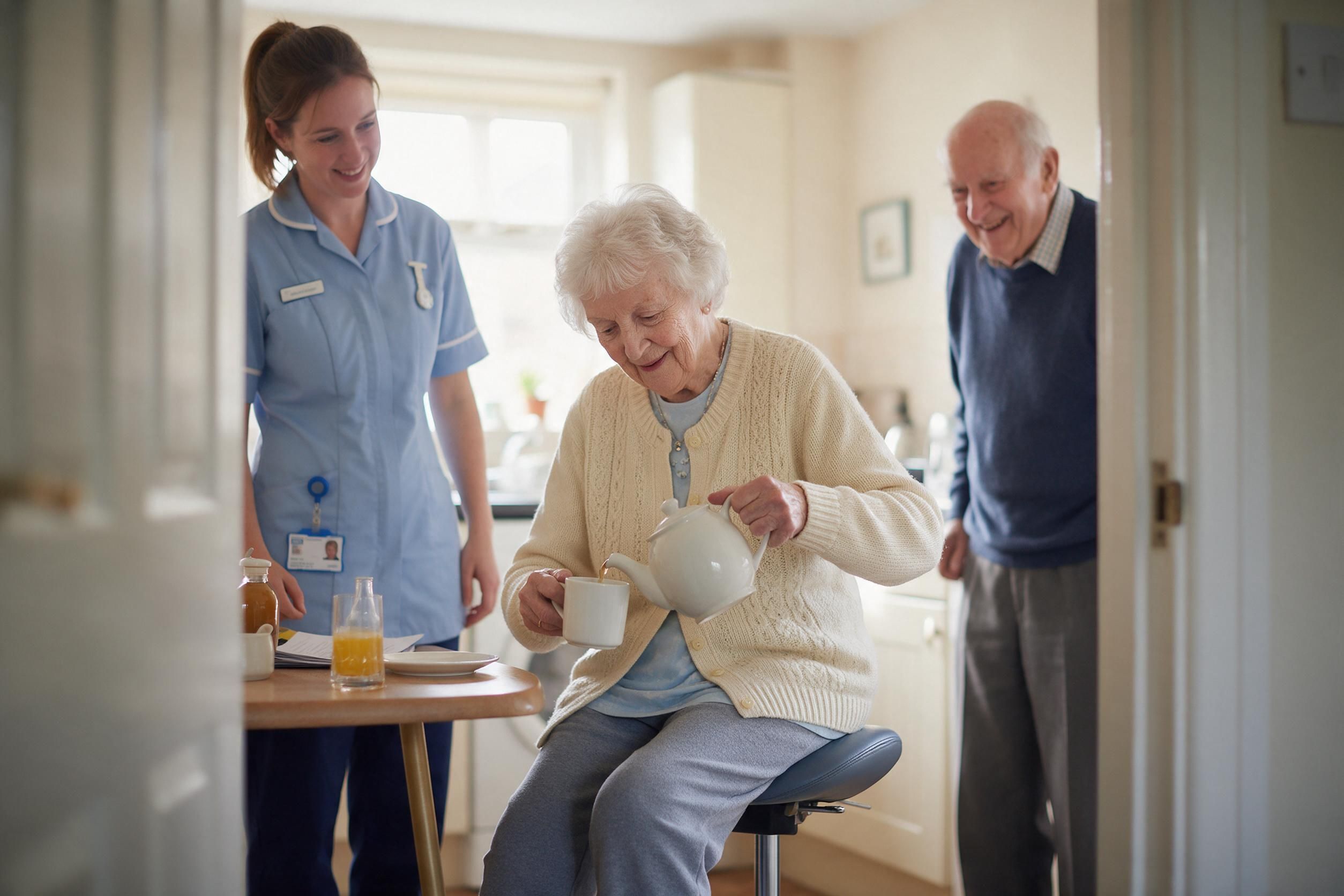
What Discharge to Assess means
Discharge to Assess, usually shortened to D2A, is the way hospitals in England now organise discharge. The idea is that people should leave hospital as soon as they no longer need hospital care, with whatever short-term support they need, and that decisions about their long-term care should be made after they have had a chance to recover.
There are good reasons for this. A hospital ward is an unfamiliar, tiring place, and many older people become weaker or more confused the longer they stay. Someone assessed on a ward may look far less able than they will be a few weeks later in their own kitchen. Assessing them at home, once they have settled, gives a fairer picture and avoids decisions, such as a permanent care home place, that might turn out to be unnecessary.
D2A is set out in the government’s Hospital Discharge and Community Support Guidance, which is statutory guidance for NHS bodies and councils in England.
The D2A pathways in brief
- Pathway 0: home with no new care, or an existing care package restarted at the same level.
- Pathway 1: home with new or extra short-term support, such as reablement, home-based rehabilitation or care visits.
- Pathway 2: a short stay in a community bed (a community hospital, rehabilitation unit or care home) to recover.
- Pathway 3: a care home for people with the most complex needs, used rarely and normally first for assessment rather than as a permanent move.
Our guide to leaving hospital explains each pathway and who is involved.
What is free, and for how long
This is the question families ask most, and the honest answer is that it depends on where you live and what support is given.
During the pandemic, the government paid for a set period of free care after discharge, first up to six weeks and later up to four weeks. That national scheme ended on 31 March 2022, which is why you may still hear people talk about “four weeks free”. Today, each area agrees its own funding arrangements between the NHS and the council, often using pooled budgets such as the Better Care Fund.
Some things are free by law, wherever you live:
- Reablement and intermediate care arranged by the council must be free for up to six weeks, whatever your savings. The statutory guidance says these services should not have a strict time limit, and that councils should consider keeping them free beyond six weeks where there is a clear benefit.
- Aids, and minor adaptations costing up to £1,000, provided by the council after an assessment.
- NHS Continuing Healthcare (CHC), for people whose needs are mainly health needs, which covers the full cost of care.
- Aftercare under section 117 of the Mental Health Act, for people who were detained under certain sections.
- Interim NHS-funded care while CHC is being decided, where the NHS has put this in place. The national framework says such interim services should continue until the decision is made, with no gap in support.
Other short-term D2A care may also be free locally for a set period, but this varies. Care that continues after the D2A period is usually means-tested. In England in 2026/27, people with capital above £23,250 normally pay the full cost of council-arranged care, and those with capital below £14,250 have that capital ignored. The value of the home you live in is not counted when care is provided at home.
What happens at the end of the D2A period

As the short-term support comes to an end, there should be a review of how the person is managing. The outcome is usually one of these:
- no further support is needed
- ongoing care at home is arranged by the council, after a care needs assessment and a financial assessment
- the person or family arranges private care
- the person is found eligible for NHS Continuing Healthcare
- a move to a care home is agreed, if home is no longer right
The guidance says that where an area funds a recovery period, no one should be left without support when it ends. Ask, before it starts, how much notice you will get of the end date and what the charges will be afterwards, so there are no surprises.
Assessments for longer-term care
Several assessments may happen during or at the end of D2A:
- Care needs assessment. The council assesses whether the person has eligible needs under the Care Act 2014, using national eligibility criteria.
- Carer’s assessment. Anyone who provides unpaid care is entitled to their own assessment. See our guide to the carer’s assessment.
- Financial assessment. Works out what, if anything, the person pays towards council-arranged care. See council funding for care.
- NHS Continuing Healthcare. Usually starts with a screening checklist. The national framework says that in the vast majority of cases screening and full assessment should happen after discharge, in the community, because an assessment in an acute hospital is unlikely to reflect longer-term needs. The decision should normally be made within 28 days of the positive checklist. People who are rapidly deteriorating and may be entering a terminal phase can be fast-tracked. Read more in our NHS Continuing Healthcare guide.
Be there for assessments if you can, and describe the bad days as well as the good ones. A short diary of what help is needed, day and night, is often more persuasive than anything said on the day.
Typical timescales
- Estimated discharge date: within 48 hours of an emergency admission.
- Safety and welfare check: on the day of discharge, for anyone needing formal support.
- Reablement and intermediate care: usually up to six weeks, often one or two.
- Local D2A funding: varies by area; ask for the exact end date.
- NHS Continuing Healthcare: a decision normally within 28 days of the integrated care board receiving a positive checklist; Fast Track care usually within 48 hours.
- Care needs and financial assessments: no fixed national deadline, but they should be completed before any free period ends, so ask for dates.
Words you can use
Asking for the funding in writing (by email to the discharge coordinator or social worker):
“Thank you for arranging support for my father, [full name] (NHS number [number]), on his discharge from [ward]. Please could you confirm in writing: what support has been arranged and by whom; which parts are free and which, if any, he will be charged for; the date any free period ends; when his longer-term needs will be assessed; and the name of our contact. Many thanks.”
Asking for an NHS Continuing Healthcare checklist:
“My mother’s needs are complex and unpredictable, and we would like her to be screened for NHS Continuing Healthcare. If it is not appropriate to do this in hospital, please confirm when and where the checklist will be completed after discharge, and that interim support will continue until a decision is made.”
Asking for notice before charges start:
“Please let us know at least two weeks before the free period ends, with a copy of the financial assessment, so we can plan.”
Documents for the financial assessment

If ongoing care may be arranged by the council, the financial assessment will go more smoothly if you have these ready:
- recent bank and building society statements for every account
- details of savings, investments and Premium Bonds
- State Pension, private pension and benefit award letters (including Attendance Allowance)
- details of any property other than the home
- the Council Tax bill and any housing costs
- receipts for disability-related expenses, such as extra heating, laundry or a community alarm, which can reduce what is charged
- a copy of any Lasting Power of Attorney or deputyship order, if someone is acting for the person
Common mistakes to avoid
- Assuming everything is free. Ask what is free, from when and until when, and get it in writing.
- Assuming nothing is free. Self-funders are still entitled to free reablement and to NHS Continuing Healthcare if eligible.
- Agreeing to a permanent care home in hospital. Long-term decisions are meant to be made after recovery.
- Missing the end date. If you are not told when free support stops, you may be charged without realising.
- Not asking for a CHC checklist when someone’s needs are complex, unpredictable or rapidly changing.
How to challenge a decision
If you disagree with an assessment or a funding decision, ask for the reasons in writing and for a copy of the assessment. Council decisions can be challenged through the council’s complaints procedure and then the Local Government and Social Care Ombudsman. NHS Continuing Healthcare decisions have their own review process, starting with the integrated care board (ICB). An independent advocate can help if the person finds it hard to take part.
How to plan ahead
D2A works best when families have thought ahead:
- Make a Lasting Power of Attorney while it is still possible, so someone can speak for the person if needed.
- Know roughly what savings and income the person has, so you can judge whether care is likely to be council-funded or self-funded.
- Talk about preferences: would they want care at home, live-in care or a care home if needs grew?
- Check what benefits they could claim, such as Attendance Allowance.
- Note the names of providers you would trust, so you are not choosing in a hurry.
What to do next
- Ask the discharge team which pathway is planned and what support it includes.
- Ask who is paying for each part, from when, until when, and request it in writing.
- Ask for a review date and the name of the person responsible for the assessment.
- Keep a simple diary of the help needed in the first weeks at home.
- If you will want private care afterwards, speak to providers before the D2A period ends.
How we can help
Since 2014 we have provided Discharge to Assess care, so we understand how D2A works from the inside and the questions families need answered. We provide live-in care anywhere in England, from £1,550 a week, and home care visits, waking nights and sleep-ins across Oxfordshire, funded privately, by councils (including direct payments) or by NHS Continuing Healthcare. If you would like support to continue, or start, when D2A care ends, our free initial assessment is a good place to begin. Call us on 01865 715780.
Common questions
Is Discharge to Assess care free?
Often for a period, but there is no longer a single national free period. Reablement and intermediate care arranged by the council or NHS must be free for up to six weeks, and many areas fund other short-term care while assessments take place. NHS Continuing Healthcare is free if you qualify. Once the short-term period ends, any ongoing council-arranged care is usually means-tested. Ask the discharge team exactly what is free, from which date and until when, and ask them to put it in writing.
How long does the D2A period last?
There is no fixed national length. The aim is to support someone until they have recovered as much as they are likely to, or their needs have settled, so a fair assessment of long-term needs can be made. Intermediate care is usually delivered for no longer than six weeks and often for one or two weeks. Some people need only a few days; others need longer. Ask for a review date at the start so you know when decisions are expected.
Can we turn down D2A support and pay for our own care?
Yes. You can decline the support offered and arrange your own care, and some families prefer to because they want a particular provider or more help than is available. Before you decide, check what you would be giving up: free reablement, for example, can sit alongside private care rather than replacing it. Tell the discharge team your plan so it is recorded, and keep the door open to council or NHS assessments later.
Will the family home be sold to pay for care after D2A?
Not if care is provided at home. The value of the home you live in is ignored in the council's financial assessment for care at home. It may be counted if someone moves permanently into a care home, but not for the first 12 weeks, and not at all while a partner, or a relative aged 60 or over or who is disabled, still lives there. Deferred payment agreements can also mean nothing is sold during the person's lifetime.
What is the difference between D2A and reablement?
Discharge to Assess is the overall approach: leave hospital promptly, recover, then be assessed. Reablement is one of the services that can be offered within it, usually short-term visits at home from workers who help you relearn everyday tasks such as washing, dressing and making a drink. Other D2A support might be home-based therapy, a restarted care package, or a short stay in a community bed.
Sources and further information
- GOV.UK: Hospital discharge and community support guidance
- GOV.UK: Care and support statutory guidance
- GOV.UK: National Framework for NHS Continuing Healthcare and NHS-funded Nursing Care
- legislation.gov.uk: Care and Support (Charging and Assessment of Resources) Regulations 2014, regulation 3
- NHS: Care to support recovery after leaving hospital
- NICE NG74: Intermediate care including reablement
Prepared by the Day and Nightcare care team. Last updated 30 October 2026; sources last checked 30 October 2026. This guide is general information about care in England, not financial, legal or medical advice.