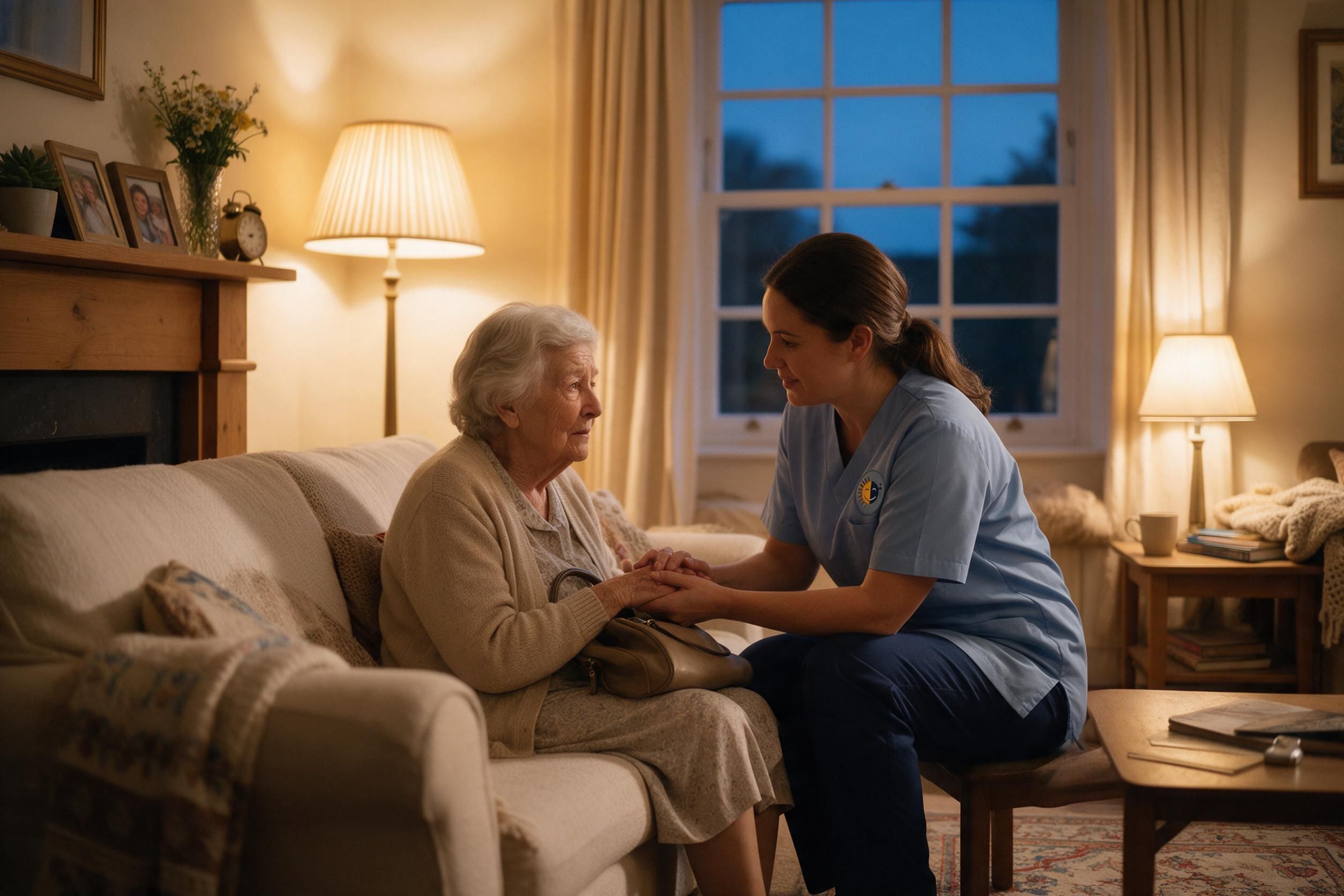
What sundowning looks like
Sundowning describes changes in behaviour that start in the late afternoon or early evening. The name is a little misleading: it is not always linked to the sun setting, and it can begin at any time from mid-afternoon. Families often notice that the person:
- becomes anxious, tearful or frightened for no clear reason
- paces, fidgets, tries to leave the house or keeps packing a bag
- asks to “go home”, or to collect children who are now grown up
- becomes suspicious, shouts or pushes away help
- sees or hears things that are not there, sometimes continuing into the night
- is more muddled about where they are or who people are
For the person, these feelings are real and often frightening. For the family, evenings can become the hardest part of the day.
What causes sundowning
Nobody knows exactly why sundowning happens, but the Alzheimer’s Society and Dementia UK list factors that make it more likely:
- Tiredness at the end of the day, for the person and for those around them.
- Unmet needs the person cannot put into words: hunger, thirst, pain, needing the toilet, feeling too hot or cold.
- Too little daylight and too little activity earlier in the day.
- Too much noise or bustle, such as television, cooking, visitors and children home from school all at once.
- A disrupted body clock, which happens in some types of dementia, including dementia with Lewy bodies.
- Shadows, reflections and dim light, which can be misread as people or threats.
- Evening cues, such as lights going on or people settling down, that make the person feel they are in the wrong place.
- Poor sight or hearing, anxiety or depression.
- Side effects of medicines.
Different causes need different answers, so the first step is to work out which ones apply.
Keep a diary for one to two weeks
The NHS suggests keeping a diary for a week or two to spot patterns. Note each evening:
- the time the unsettled behaviour started and how long it lasted
- what happened in the hour before: visitors, a nap, a meal, a phone call, the television
- what the person said or did, and what they seemed to be feeling
- whether they had eaten, had a drink, been to the toilet and been outside that day
- what helped, and what made it worse
After a fortnight, patterns often jump out: a long afternoon nap, no drink since lunch, or the six o’clock news.
A daytime routine that makes evenings easier

- Get daylight early. Time outdoors in the morning or early afternoon helps set the body clock. If going out is hard, a favourite chair by a window helps.
- Keep active. A walk, gardening, folding laundry, music or seated exercise during the day can improve sleep and reduce evening restlessness.
- Keep naps short and earlier in the day.
- Plan the late afternoon. Have a calm, familiar activity ready for the time trouble usually starts: a drink and a snack, favourite music, looking at photographs, a simple task.
- Offer drinks and food regularly. Hunger and thirst are easy to miss.
- Cut down caffeine and alcohol in the afternoon and evening.
- Keep to the same order of events each evening: tea, a wash, nightwear, a drink, bed.
Setting up the home for the evening
- Close curtains or blinds as it starts to get dark, and put lights on before the room becomes gloomy. In winter, after the clocks go back, this means doing it earlier.
- Keep lighting even. Shadows and dark corners can look like people.
- Cover mirrors or a blank television screen if reflections cause alarm.
- Turn down background noise, and keep evening visits small and calm.
- Use a clock that shows the day, date and whether it is morning or evening.
- Put a night light on the route to the toilet, and keep the route clear.
What to do and say in the moment
When someone is distressed, reasoning rarely helps. The aim is to help them feel safe.
- Stay calm, speak slowly and use short sentences. Sit down beside them rather than standing over them.
- Check for a need first: “Are you cold? Shall we go to the toilet? Would you like a cup of tea?”
- Respond to the feeling, not the facts. Avoid contradicting or arguing.
- Offer a gentle change of scene: another room, a short walk, some music.
- If they are becoming angry, give them space and come back in a few minutes.
Words that often help:
“You’re safe. I’m here with you. Let’s sit down together and have a cup of tea.”
“You sound worried. Tell me what’s on your mind.”
“Your children are fine. Tell me about when they were little.”
When it carries on into the night
Disturbed nights are one of the main reasons family carers become exhausted. If the person wakes and walks about, keep the house safe: a night light, a clear route to the toilet, and door sensors or other telecare from the council’s adult social care team. If there is a risk they might leave the house, ask your local police force about the Herbert Protocol, a form you fill in now to help police act quickly if someone goes missing.
Night care can give the family their sleep back: a sleep-in carer who can be woken occasionally, or a waking night carer for someone up and needing help through the night.
Looking after yourself
 Sundowning is hard to live with, and your tiredness can make the person more unsettled. Ask the council for a carer’s assessment, plan regular breaks using respite care, and tell the GP practice you are a carer. If you feel low or overwhelmed, the GP can help, and Samaritans are there on 116 123, free, 24 hours a day.
When to seek help
Call 999 or go to A&E if the person suddenly becomes confused, very drowsy or has difficulty speaking, or shows signs of a stroke. The NHS treats sudden confusion as an emergency.
Ask for an urgent GP appointment or call NHS 111 (free, 24 hours) if:
- evening agitation has started or worsened over a few days, without sudden confusion (sudden confusion needs 999 or A&E, as above)
- there are signs of a urine infection: the NHS says older or frail people and people with dementia may become agitated or confused, leak urine more than usual, or have new shivering or shaking
- they have barely eaten or drunk, have dark urine or seem unusually tired
- they seem to be in pain
Book a routine GP appointment if sundowning is a regular pattern, to check for pain, constipation, poor sleep, low mood and medicine side effects. Take your diary.
What to tell the GP
- When the evening changes started, and whether they came on suddenly or gradually.
- What the diary shows: times, triggers and what helps.
- Any recent illness, fall, constipation, change in eating or drinking.
- Any new or changed medicines, including ones bought over the counter.
- How nights are going for the person and for you.
See our guide to sudden confusion and delirium for the signs that something more urgent is going on.
Where to get support
- Dementia UK Admiral Nurse Dementia Helpline: 0800 888 6678 (free). Monday to Friday 9am to 9pm, weekends 9am to 5pm. Email helpline@dementiauk.org.
- Alzheimer’s Society Dementia Support Line: 0333 150 3456. Monday to Wednesday 9am to 8pm, Thursday and Friday 9am to 5pm, weekends 10am to 4pm.
- Carers UK Helpline: 0808 808 7777. Monday to Friday, 9am to 6pm.
- Samaritans: 116 123 (free), 24 hours a day.
What to do next
- Start a simple evening diary tonight and keep it for one to two weeks.
- Plan more daylight and activity in the morning, and a calm activity for late afternoon.
- Close curtains and put lights on before dusk, and quieten the house in the evening.
- Book a GP review to check for pain, infection, constipation and medicine side effects.
- Ask the council about telecare, a carer’s assessment and breaks for you.
How we can help
Day and Nightcare provides fully managed live-in dementia care anywhere in England, from £1,550 a week, and home care visits, sleep-ins and waking nights across Oxfordshire, and 24-hour care with carers working in shifts anywhere in England. A consistent carer who knows the person’s evening routine can make a real difference to how the end of the day feels. To talk it through, call us on 01865 715780 and we can arrange a free assessment.
Common questions
Is sundowning a sign that dementia is getting worse?
Not necessarily. Sundowning can happen at any stage of dementia, although the Alzheimer's Society says it is more common in the middle and later stages. It may come and go over weeks or months, and some people never have it. What matters is a sudden change: if evening confusion appears out of the blue or becomes much worse over a day or two, it may be delirium caused by an infection, pain or a medicine, and needs urgent medical help. The NHS advises calling 999 or going to A&E if someone suddenly becomes confused.
How common is sundowning?
Dementia UK estimates that about one in five people with dementia experience sundowning. It is more common in the middle and later stages, and can be more frequent after a move, a room change or in a busy household in the evening. Not everyone with dementia has it, and someone who does may not have it every evening, which is why a short diary of good and bad evenings is so useful.
Is there medication for sundowning?
Usually not for sundowning itself. Dementia UK says it is best managed with routines and changes to the environment. Doctors first look for treatable causes, such as pain, infection, depression or side effects of medicines. If distress or aggression continues despite everything else, the NHS says a specialist may prescribe an antipsychotic medicine for a short time. Talk to the GP before trying any sleep remedy, including ones bought over the counter.
My dad wants to 'go home' every evening, but he is at home. What should I say?
Try not to argue or correct him. 'Home' often means a feeling of safety, comfort or an earlier time in life, rather than a building. Respond to the feeling instead: 'You want to go home. Tell me about home.' Talking about the house he grew up in, offering a warm drink or going for a short walk together often settles the urge better than explaining that he already lives there.
Can a live-in carer help with sundowning?
Yes, often a great deal. A live-in carer keeps the day's routine steady, gets the person outside in daylight, notices the early signs of an unsettled evening and knows what calms them. A carer the person knows, already there in the evening, is often less unsettling than a change of visiting carers at teatime. If the person is up and needing help most nights, a waking night carer may be needed as well, so that everyone can rest.
Sources and further information
- Alzheimer's Society: Sundowning and dementia
- Dementia UK: Sundowning
- NHS: Coping with dementia behaviour changes
- NHS: Sudden confusion (delirium)
- NHS: Urinary tract infections (UTIs)
Prepared by the Day and Nightcare care team. Last updated 30 October 2026; sources last checked 30 October 2026. This guide is general information about care in England, not financial, legal or medical advice.