The NHS is free at the point of use, but some charges remain: prescriptions, dental treatment, glasses, wigs and travel to appointments. Older people are exempt from some and can get help with the rest. This guide covers England for April 2026 to March 2027; in Scotland, Wales and Northern Ireland prescriptions are free for everyone and other rules differ.
At a glance
| Cost | Free from age 60? | Who else can get help |
|---|---|---|
| Prescriptions | Yes | Medical exemption certificate, some benefits, HC2 |
| NHS sight tests | Yes | Diabetes, glaucoma, sight loss, some benefits, HC2 |
| Glasses and contact lenses | No | Vouchers with some benefits, HC2 or HC3 |
| Dental treatment | No | Some benefits, HC2; part help with HC3 |
| Hearing aids | Free for everyone on loan | Not applicable |
| Travel to hospital | No | Some benefits, HC2 or HC3 |
“Some benefits” here mainly means Pension Credit Guarantee Credit, income-related Employment and Support Allowance and, depending on earnings, Universal Credit. Attendance Allowance and PIP do not count. If you are over State Pension age, check whether you can get Pension Credit: even a small award unlocks most of the help below.
Prescriptions
From 60: every prescription is free. The pharmacy can usually see the date of birth on the form; otherwise tick the age box on the back.
Under 60 (often the family carer): the charge is £9.90 an item in 2026/27. If you need more than a few items a year, a prescription prepayment certificate (PPC) covers all your NHS prescriptions for a fixed price:
- £32.05 for 3 months;
- £114.50 for 12 months, which can be paid in 10 monthly direct debits.
Buy one online from the NHS Business Services Authority (NHSBSA), at some pharmacies, or by phone on 0300 330 1341.
Medical exemption certificate: people under 60 get free prescriptions if they have diabetes (unless treated by diet alone), epilepsy needing continuous medication, an underactive thyroid needing hormone replacement, a permanent stoma or fistula needing dressings or an appliance, Addison’s disease and some other gland conditions, myasthenia gravis, a continuing physical disability that means they cannot go out without help from another person, or are being treated for cancer or its effects. Ask the GP for the application form.
Wrongly claiming free prescriptions can lead to a penalty of up to £100.
The NHS Low Income Scheme
This scheme gives help to people on a low income who do not get a qualifying benefit. You can apply if your savings, investments and property (not counting your home) are no more than £16,000, or £23,250 if you live permanently in a care home.
- An HC2 certificate gives full help: free prescriptions, dental treatment, sight tests, travel to appointments, wigs and fabric supports, and vouchers towards glasses.
- An HC3 certificate shows how much you must pay towards each cost; the NHS covers the rest.
How to apply:
- Apply online on the NHSBSA website if your savings are £6,000 or less; otherwise use the paper HC1 form, which you can order online, download, or collect from a Jobcentre Plus office or NHS hospital.
- Have ready proof of income (pensions, benefits, earnings), savings and investments, and housing costs such as rent or mortgage payments, for you and any partner.
- Applications are usually assessed within 18 working days. Certificates last between six months and five years.
- For help, call 0300 330 1343 (Monday to Friday 8am to 6pm, Saturday 9am to 3pm).
Eye tests and glasses
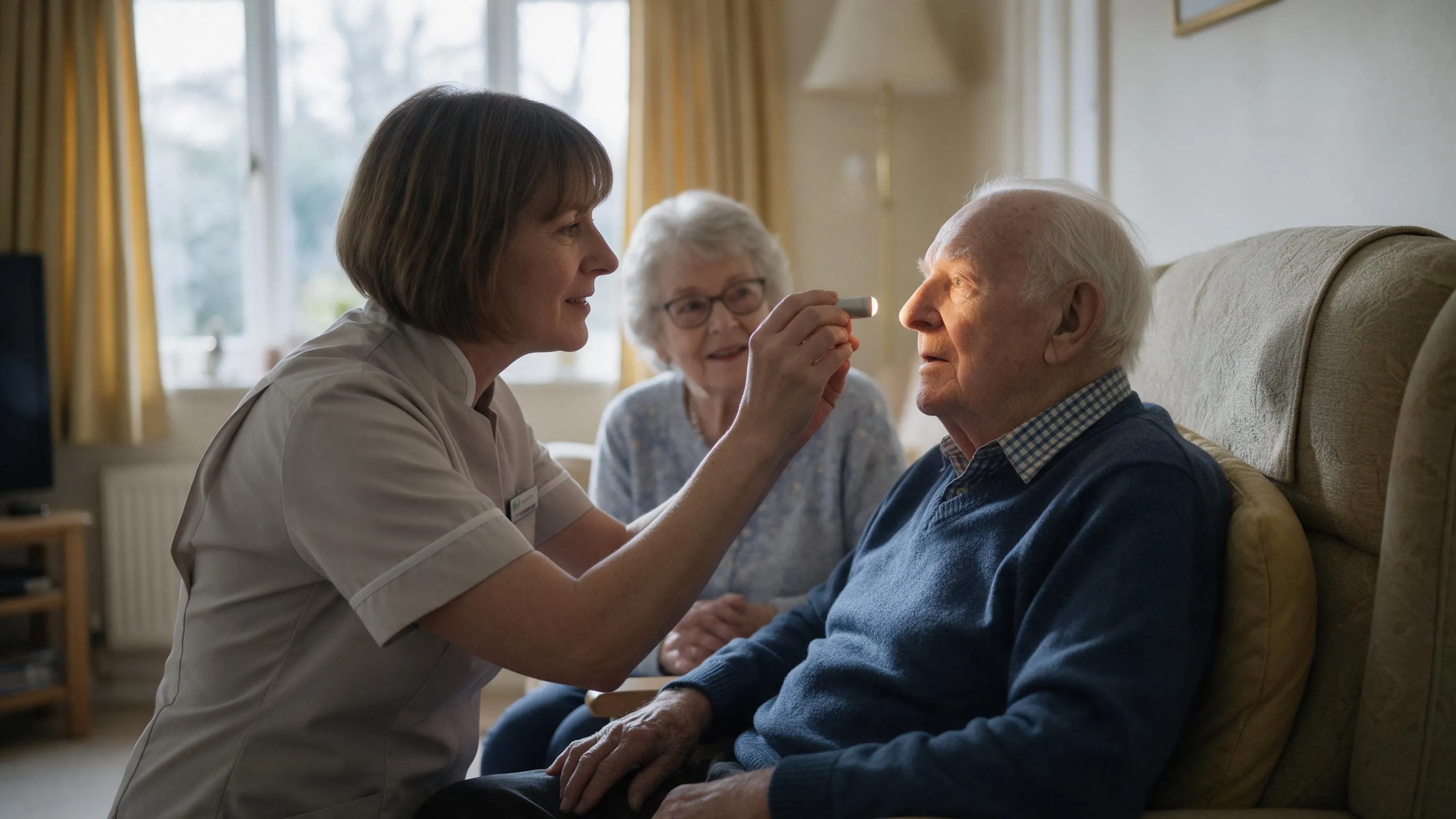
NHS sight tests are free from 60, and at any age for people with diabetes or glaucoma, people at risk of glaucoma, and people registered as sight impaired. Home visits are possible for people who cannot get out (see the questions below).
Free tests do not mean free glasses. Optical vouchers towards glasses or contact lenses go to people on Pension Credit Guarantee Credit, income-based Jobseeker’s Allowance, Universal Credit (if they meet the conditions), or with an HC2 or HC3 certificate. See sight and hearing loss for more on eye care.
Dental treatment
There is no age exemption for dental care. The NHS charges in England from 1 April 2026 are:
| Course of treatment | Charge |
|---|---|
| Urgent treatment | £27.90 |
| Band 1: examination, diagnosis, X-rays, scale and polish if needed | £27.90 |
| Band 2: Band 1 plus fillings, root canal work or extractions | £76.60 |
| Band 3: Band 2 plus crowns, dentures or bridges | £332.10 |
You pay one charge for each course of treatment, at the highest band it reaches. Who pays nothing is covered in the questions below. Dental queries: 0300 330 1348.
Hearing aids
NHS hearing aids are provided free on long-term loan, and batteries and repairs are free too. A charge may apply if an aid is lost or broken and has to be replaced. Ask the GP for a referral to the NHS hearing service.
Wigs and fabric supports
NHS wigs, surgical bras and abdominal or spinal supports carry a charge unless the person is a hospital inpatient, gets one of the qualifying benefits above or has an HC2 certificate (HC3 gives part help).
Travel to hospital and other appointments

The Healthcare Travel Costs Scheme refunds reasonable travel costs to NHS appointments for people who get Pension Credit Guarantee Credit, income-related Employment and Support Allowance, Universal Credit (if they meet the conditions), or have an HC2 or HC3 certificate.
- The appointment must be for specialist or hospital care that a GP, dentist or other healthcare professional has referred you to, on a separate visit from the referral.
- Refunds are based on the cheapest suitable way to travel. Drivers get a mileage rate and can usually claim unavoidable parking. Agree any taxi with the hospital before you travel.
- An escort’s travel can be paid if a healthcare professional says it is medically necessary.
- Claim within three months: take tickets, receipts, the appointment letter and proof of benefit to the hospital cashier, or post form HC5(T).
If a medical condition means someone cannot travel safely any other way, ask the GP surgery or hospital about non-emergency patient transport; eligibility is checked against set criteria each time.
Hospital car parks in England must be free for Blue Badge holders, whether patients or visitors, and for outpatients attending at least three times in a month. Many hospitals also offer concessions for relatives visiting someone who is gravely ill, and for carers: ask at the main reception.
Your health costs checklist
- Free prescriptions (60+) or a PPC or exemption certificate for anyone under 60
- Pension Credit checked
- NHS Low Income Scheme applied for, if savings are under the limit
- Free sight test booked, at home if needed
- Glasses voucher asked for, if eligible
- Receipts kept for travel, dental and optical costs
- Blue Badge shown for free hospital parking
What to do next
- Check Pension Credit first, because it unlocks most of this help.
- If Pension Credit is not payable, apply for the NHS Low Income Scheme.
- Keep receipts and claim refunds within three months.
- Carers under 60 who pay for regular prescriptions: buy a PPC.
How we can help
Day and Nightcare is a CQC-registered home care provider, rated Good, supporting people at home since 2008. Our fully managed live-in care is available anywhere in England from £1,550 a week, and we offer home care visits and waking nights across Oxfordshire, and 24-hour care with carers working in shifts anywhere in England. Our guide to reducing the cost of care brings together the main ways to make care more affordable. For a free initial assessment and a written quote, call 01865 715780.
Common questions
Does Attendance Allowance give free dental treatment or help with hospital travel?
No. Attendance Allowance and PIP are not qualifying benefits for free dental treatment, glasses vouchers or the Healthcare Travel Costs Scheme. The benefits that count include Pension Credit Guarantee Credit, income-related Employment and Support Allowance and, depending on income, Universal Credit. Someone on Attendance Allowance with a modest income and savings of £16,000 or less can still apply for the NHS Low Income Scheme, and should also check whether they are entitled to Pension Credit.
Are dental check-ups free for pensioners?
Not because of age. In England there is no free dental treatment at 60 or over, so a check-up is a Band 1 course of treatment costing £27.90 from 1 April 2026. It is free for people who get Pension Credit Guarantee Credit, income-related ESA or Universal Credit with a low enough income, or who have an HC2 certificate, and cheaper with an HC3 certificate. Repairs to dentures are free, but new dentures are charged if a repair is not possible.
Can someone who cannot leave home get an eye test at home?
Yes, in many cases. People who qualify for a free NHS sight test, which includes everyone aged 60 or over, can have it at home if they cannot get to an optician on their own because of physical or mental illness or disability. People in care homes and some day centres can qualify too. Ask local opticians whether they provide NHS sight tests at home, and mention any hearing, memory or mobility needs when you book, so the visit can be planned around them.
I paid for treatment while waiting for my HC2 certificate. Can I get the money back?
Yes, if the certificate covers the date you paid. Claim within three months of paying. For dental treatment, glasses, travel or wigs, use the matching HC5 refund form from the NHS Business Services Authority website. For prescriptions, you can only claim if you asked for an FP57 receipt and refund form when you paid, because pharmacies cannot issue one later. If you are unsure whether you qualify, it is safer to pay and ask for a receipt.
Can someone living in a care home apply for the NHS Low Income Scheme?
Yes. The savings limit is higher for people who live permanently in a care home: £23,250 in savings, investments and property, compared with £16,000 for everyone else in England. A certificate can help with dental treatment, glasses, travel to appointments and other NHS charges; prescriptions and sight tests are already free from 60. A relative or attorney can help with the application, and the NHS Business Services Authority helpline on 0300 330 1343 can explain the process.
Sources and further information
- NHSBSA: Prescription prepayment certificates
- NHSBSA: Free NHS prescriptions
- GOV.UK: Prescription charge frozen at £9.90 for 2026 to 2027
- NHS.uk: NHS Low Income Scheme
- NHS.uk: Free NHS eye tests and optical vouchers
- NHSBSA: Current NHS dental charges (from 1 April 2026)
- NHS.uk: Healthcare Travel Costs Scheme
- GOV.UK: NHS patient, visitor and staff car parking principles
Prepared by the Day and Nightcare care team. Last updated 30 October 2026; sources last checked 30 October 2026. This guide is general information about care in England, not financial, legal or medical advice.