
When the council works out what someone pays towards care at home, it can count disability benefits such as Attendance Allowance as income. Those benefits exist to meet the extra costs of disability, so the Care and Support Statutory Guidance says the council should let the person keep enough of them to pay for necessary disability-related expenditure that it is not meeting (paragraph 8.42 and Annex C, paragraphs 39 to 41). Every £1 a week of DRE the council accepts takes £1 off the weekly charge, unless the charge is already nil or is limited to the cost of the care: £30 a week is £1,560 a year. This applies in England.
When DRE applies
- The council arranges or funds care outside a care home (at home, in extra care housing or in supported living) and charges for it.
- The council counts a disability benefit as income, such as Attendance Allowance, the daily living part of PIP or the care part of DLA.
Care homes have separate rules. See Financial assessment for care at home for the full calculation.
What counts: the statutory guidance list
Annex C, paragraph 40, lists costs councils should include. In plain English:
- a community alarm or telecare system
- privately arranged care, including respite care, and day or night care the council is not arranging
- specialist washing powder or extra laundry
- the extra cost of a special diet needed because of illness or disability (the council may ask to check with the GP)
- specially made clothing or footwear, or extra wear and tear caused by disability
- extra bedding, for example because of incontinence
- heating, or metered water, above the average for the area and type of home
- reasonable costs of basic gardening, cleaning or domestic help needed because of the disability and not provided by social services
- buying, maintaining and repairing disability equipment, including IT where the disability makes it necessary, and reasonable hire costs while waiting for council equipment
- personal assistance costs
- internet access, for example for blind and partially sighted people
- transport costs caused by illness or disability, beyond any PIP or DLA mobility payment available for them
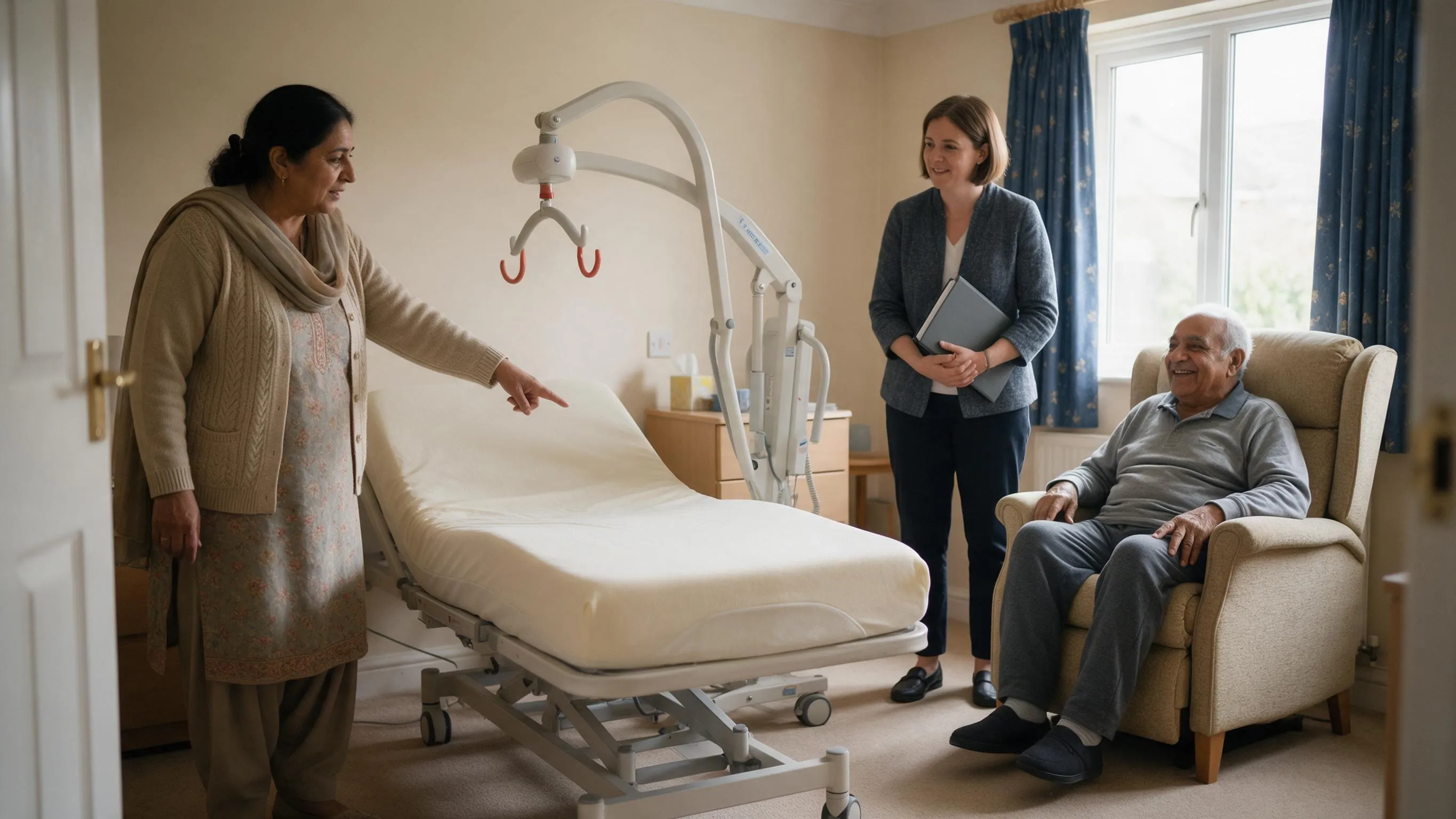
The list “is not intended to be exhaustive”, and “any reasonable additional costs directly related to a person’s disability should be included”. Paragraph 41 adds that DRE “should not be limited to what is necessary for care and support”. So you can argue for other costs, such as the electricity used by an air mattress, a hoist or an electric riser chair, if you can show they arise from the disability.
If the council counts the higher rate of Attendance Allowance but funds no care at night, any night care paid for privately is a strong item to list, because the higher rate is usually awarded for help needed by night as well as by day.
What the council may refuse
- Costs that everyone has anyway: only the extra cost caused by disability counts.
- Items available more cheaply, for example continence pads the NHS would supply (ask the GP or district nurse for a continence assessment).
- Transport costs where suitable cheaper transport, such as council-provided transport, is available but not used.
- Anything the council or the NHS is already providing.
Standard allowances or an individual assessment
Councils handle DRE in different ways. Many give everyone whose disability benefits are counted a standard allowance, either a fixed weekly amount or a share of the benefit, and offer an individual assessment if costs are higher. Others assess each person’s costs from the start. Read the council’s charging policy to see which it uses.
A standard allowance is simple but may be far below real costs for someone with high needs. The guidance says the council should assess and allow enough to pay for necessary costs, so if yours are higher than the standard amount, ask for an individual assessment and send evidence.
How to work out the weekly cost
- Heating: compare 12 months of bills with a year before the illness if you have them, or ask the energy supplier for annual usage. The council will compare with what is typical for the area and type of home.
- Laundry: count the extra loads a week and cost each one (powder, electricity, water).
- Diet: keep receipts for special products and note what an ordinary equivalent would cost.
- Equipment: keep receipts, and ask how the council turns a one-off purchase into a weekly amount.
- Care, cleaning and gardening: invoices, with a line on why the person cannot do the task themselves.
- Transport: taxi receipts or a mileage log for journeys made because of illness or disability.
Evidence to keep
- Invoices for privately paid care, cleaning or gardening
- 12 months of energy bills, and metered water bills
- Receipts for washing products, bedding, clothing, footwear and special foods
- Community alarm or telecare bills
- Receipts for buying, repairing or hiring equipment
- Taxi receipts or a mileage log
- Any letter from the GP, a dietitian or an occupational therapist explaining the need
- One page listing each cost as a weekly figure
How to ask

- Ask the council for its charging policy and any DRE form.
- List every cost as a weekly figure, using the methods above.
- Send the list and evidence with the financial assessment form, or later as a request for review.
- Ask for a written breakdown showing which items were accepted, which were refused and why.
- If costs change, ask for a reassessment.
Template request: “I am writing about the financial assessment for [full name, date of birth, reference]. [He/She] receives [Attendance Allowance at the higher rate], which the council counts as income. Under paragraph 8.42 and Annex C, paragraphs 39 to 41, of the Care and Support Statutory Guidance, please carry out an individual assessment of [his/her] disability-related expenditure. The enclosed list shows weekly costs of £[total], made up of [extra heating £x, laundry £x, community alarm £x, private night care £x], with evidence for each. Please confirm in writing which costs you accept, give reasons for any you do not, and recalculate the weekly charge from [date].”
If DRE is refused
- Ask for the reasons in writing for each item refused.
- Ask for a review, pointing out that the guidance list is not exhaustive and should not be limited to the care plan, and add any missing evidence.
- Make a formal complaint through the council’s complaints procedure, normally within 12 months.
- If you are still unhappy, contact the Local Government and Social Care Ombudsman: free, online at lgo.org.uk or on 0300 061 0614 (Monday, Tuesday, Thursday and Friday 10am to 1pm; Wednesday 1pm to 4pm).
Free help with a DRE claim is available from the Age UK Advice Line on 0800 678 1602 (every day, 8am to 7pm) and the Independent Age helpline on 0800 319 6789 (Monday to Friday, 8.30am to 5.30pm).
What to do next
- Check whether the council counts a disability benefit in the financial assessment.
- Read the charging policy to see how DRE is handled.
- Spend a week listing every extra cost, and start a folder of receipts.
- Send the list with the template request above.
- Diary a yearly check, and ask for a reassessment when costs change.
How we can help
Day and Nightcare is a CQC-registered home care provider, rated Good, supporting people at home since 2008. We provide care funded by councils (including direct payments), privately and by NHS Continuing Healthcare, including fully managed live-in care anywhere in England from £1,550 a week, and home care visits, waking nights and sleep-ins across Oxfordshire. Call 01865 715780 for a free initial assessment, or contact us.
Common questions
Does DRE matter if we pay for all our care ourselves?
Not while you pay a provider directly with no council involvement. DRE is part of the council's financial assessment, so it only reduces a charge the council makes. People who fund their own care keep all their Attendance Allowance or PIP. It is still worth keeping receipts now: if savings fall towards £23,250 and the council starts to contribute, you will be able to show your disability-related costs from the first assessment.
Can the cost of a privately paid carer count as DRE?
Yes, where the care is needed and the council is not arranging it. The statutory guidance lists privately arranged care, including respite, and day or night care not arranged by the council. For example, if the council funds daytime visits but the family pays privately for help at night, that night care can be listed as DRE. Send the invoices and explain why the care is needed.
What if the person does not get a disability benefit?
Then DRE usually has nothing to protect, because the guidance links it to disability benefits the council counts as income. The minimum income guarantee and the deduction for housing costs still apply. Check whether the person should be claiming Attendance Allowance or the daily living part of PIP: if one is awarded, the council may count it, but it must then allow for the person's disability-related costs.
Will claiming DRE affect any benefits?
No. DRE is not a benefit and nothing is paid to you. It is an amount the council takes off the person's income when it works out what they can afford to pay for care, so it only changes the council's charge. Attendance Allowance, PIP, Pension Credit and other benefits carry on exactly as before.
Is there a deadline for asking the council to look at DRE again?
You can ask for a reassessment at any time, for example when new costs arise; the guidance says councils should reassess when circumstances change or the person asks. If you want to complain that DRE was wrongly refused in the past, a complaint should normally be made within 12 months of the decision, or of when you found out about it, so act promptly.
Sources and further information
- GOV.UK: Care and support statutory guidance (chapter 8 and annex C, paragraphs 39 to 41)
- GOV.UK: Social care charging for care and support 2026 to 2027 (local authority circular)
- legislation.gov.uk: Local Authority Social Services and NHS Complaints (England) Regulations 2009, regulation 12
- Local Government and Social Care Ombudsman: make a complaint
Prepared by the Day and Nightcare care team. Last updated 30 October 2026; sources last checked 30 October 2026. This guide is general information about care in England, not financial, legal or medical advice.