
Start with what they want
Before arranging anything, talk with your relative about how they feel things are going. What is working? What worries them? What would they like help with, and what would they rather keep doing themselves? Who already helps? Their wishes should shape everything that follows, and agreeing together what information can be shared with you avoids awkward moments later.
Get the permissions in place
When you live far away, much of your caring happens by phone and email. Organisations will only talk to you if they are allowed to.
- Lasting Power of Attorney (LPA): there are two types, one for property and financial affairs and one for health and welfare. An LPA can only be made while the person has mental capacity, so do not leave it too late. The steps are below, and our Lasting Power of Attorney guide explains more.
- GP practice: ask the person to tell the practice that you may be contacted and can be given information. You can also apply for family and carer access, which can let you order repeat prescriptions or book appointments online. To use it through the NHS App you need to be registered at the same practice. If you are not, the practice can give you separate login details.
- Energy and water suppliers: joining the Priority Services Register is free. It lets your relative nominate you to receive bills and letters, and gives them a password scheme for genuine callers and priority help in a power cut.
- Banks and benefits: ask the bank about a third-party mandate while your relative can still agree to it. If someone can no longer manage their benefits, the Department for Work and Pensions can appoint a person to act for them.
Making a Lasting Power of Attorney: step by step
- Agree who the attorneys will be. Choose people your relative trusts, aged 18 or over. Talk about their wishes.
- Fill in the forms. The easiest way is the GOV.UK online service, which creates the forms for you. Your relative can also use paper forms.
- Find a certificate provider. This is someone aged 18 or over who confirms your relative understands the LPA and is making it by choice, such as a long-standing friend or a professional like a GP or solicitor.
- Print and sign. Everyone signs the same original document: your relative, the certificate provider and the attorneys, with witnesses aged 18 or over where required. An attorney cannot witness your relative’s signature. Copies and digital signatures are not accepted.
- Register it with the Office of the Public Guardian. It costs £92 for each LPA, with reductions for people earning under £12,000 and possible exemptions for those on certain benefits. It takes about 8 to 10 weeks if there are no mistakes.
- Use it. Once registered, give copies to the bank, GP and others as needed.
The Office of the Public Guardian helpline is 0300 456 0300 (Monday, Tuesday, Thursday and Friday 9am to 5pm, Wednesday 10am to 5pm).
Getting family and carer access at the GP practice: step by step
- Ask your relative whether they are happy for you to help with their GP services online.
- Contact their GP practice and ask for “family and carer access” (also called proxy access).
- Fill in the practice’s form. You may both need to show photo ID.
- The practice decides what you can do, such as ordering repeat prescriptions, booking appointments or seeing parts of the record.
- If you are registered at the same practice, you can use it in the NHS App. If not, the practice will give you separate login details.
Ask for assessments
The council where your relative lives is responsible for both their needs assessment and your carer’s assessment, wherever you live. A carer’s assessment should recognise the time and worry involved in caring from afar: the calls, the travel, the organising and the sleepless nights.
Build a local network

The single most useful thing a distant carer can have is a few people nearby.
- A neighbour or friend who can pop in, hold a spare key and call you if something seems wrong.
- A key safe by the door, so carers or paramedics can get in. Keep the code to a small, trusted group.
- Local contacts: the GP surgery, pharmacy, the council’s adult social care team, the local Age UK and the local carers’ centre.
- Faith groups, clubs or day centres the person already knows.
Write everyone’s details on one sheet and keep copies at your home and theirs.
Use technology wisely
Technology can fill some of the gaps between visits, as long as your relative agrees and it solves a real problem.
- A personal alarm or fall detector linked to a 24-hour response centre, with you and a local contact as responders.
- Telecare sensors that alert someone if, for example, the front door opens at night or the home gets too cold.
- Video calls on a simple tablet, set up so they can answer easily.
- A shared online calendar for appointments, visits and deliveries.
Landlines are moving from analogue to digital, with most homes expected to switch by January 2027. If your relative has an alarm that uses the phone line, tell their phone provider and check the alarm will still work. Our guide to technology and telecare covers this in detail.
Working with a care provider from afar
If your relative has paid care, the relationship with the provider becomes your eyes and ears. When you choose one, ask:
- Who is my named contact, and how quickly will they reply?
- How and how often will you update me?
- Can I see the daily care notes, and how?
- What happens if a carer is ill or delayed?
- What is the out-of-hours number?
- How will you tell me about falls, illness or changes in mood?
- When will the care plan be reviewed, and can I take part?
Always check the provider is registered with the CQC and read its latest inspection report. Our guide to choosing a care provider has a fuller checklist.
For families who live far away, live-in care can bring particular peace of mind, because a regular carer lives in the home, is close by day and night, and can keep you informed. With a fully managed service, the provider also arranges cover for the carer’s breaks. If your relative needs nursing care around the clock, a nursing home may suit better, and it is worth comparing both. Our page on live-in care versus a care home sets out the differences.
Make an emergency plan
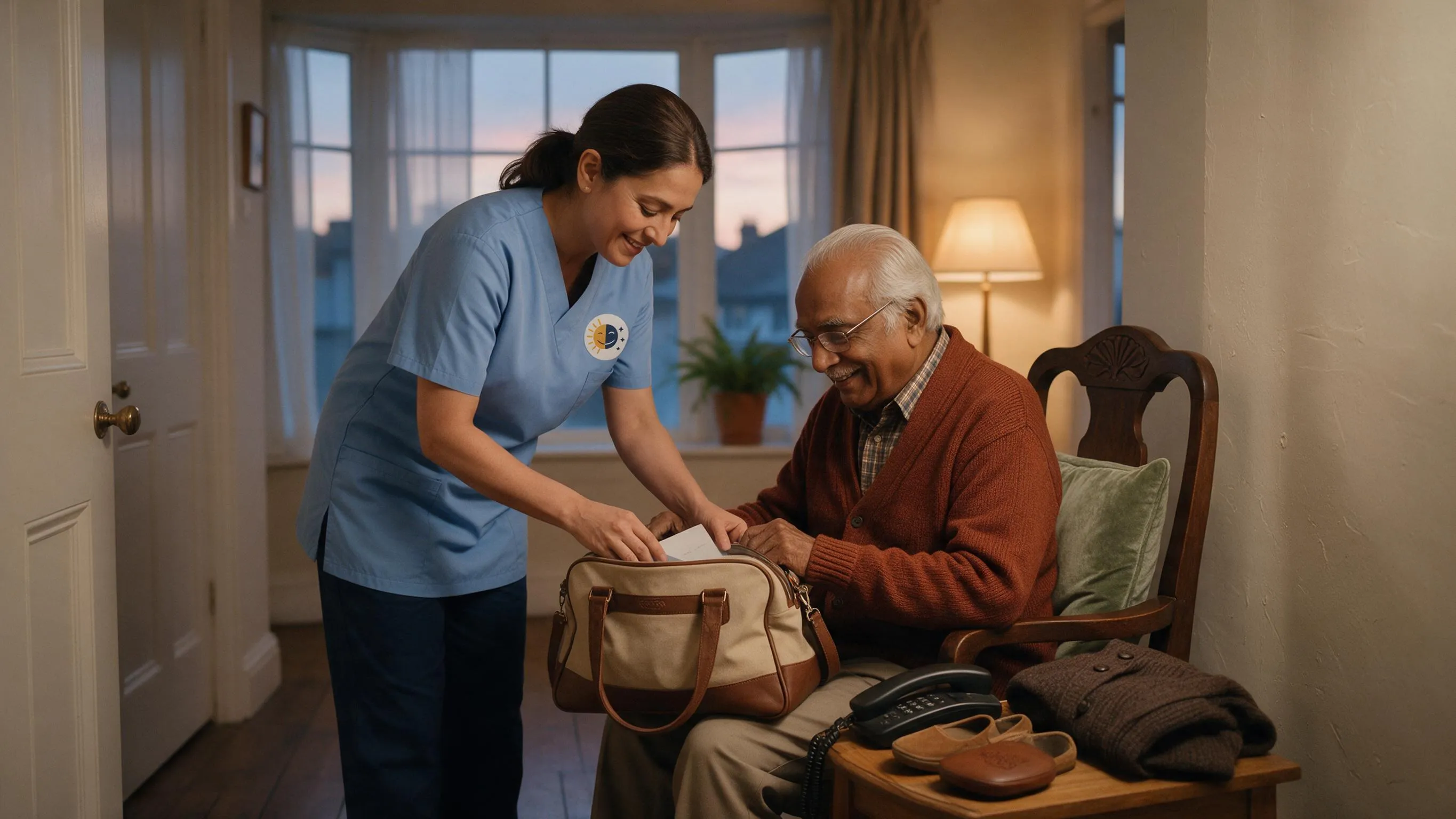
Agree a plan before you need it, so the first call in a crisis is not a scramble. Fill in this “grab sheet” with your relative, keep one copy in their home where paramedics can find it, for example near the phone or on the fridge, and keep one yourself.
Emergency grab sheet: template
- Name, date of birth and address:
- NHS number:
- GP practice and phone:
- Pharmacy and phone:
- Conditions:
- Current medicines: (attach the latest repeat prescription list)
- Allergies:
- Mobility: for example, walks with a frame, needs help to stand.
- Communication: hearing aids, glasses, memory problems, first language.
- ReSPECT form, advance decision or LPA: yes or no, and where kept.
- First person to call: name, relationship, phone.
- Local key holder: name and phone.
- Care provider and out-of-hours number:
- Pets and who will care for them:
- Things that help me feel calm:
Also agree what happens if you are ill or away yourself. If your relative has dementia, ask their local police force whether it uses the Herbert Protocol, a form that holds key information in case someone goes missing.
Make every visit count
Visits are precious, so it helps to look out for early signs of change, gently and without turning the visit into an inspection.
- Food in the fridge: is it fresh, and is it being eaten?
- Post: unopened letters, unpaid bills or a pile of junk mail that could signal scams.
- Medicines: are there unused tablets or a jumble of old boxes?
- The home: is it warm enough, tidy, and free of new hazards? Are smoke alarms working?
- The person: weight, clothes, hygiene, mobility, mood and memory.
Try to go with them to an important appointment, meet any carers, and leave time simply to enjoy being together.
Look after yourself too
Long journeys, guilt and constant worry take a toll. Use your rights at work, such as carer’s leave, and share the load with siblings by giving each person a clear role, for example one handling money and another health appointments. Our guide to working while caring explains your rights.
Useful helplines
- Carers UK: 0808 808 7777, Monday to Friday, 9am to 6pm.
- Age UK Advice Line: 0800 678 1602.
- Independent Age: 0800 319 6789, Monday to Friday, 8.30am to 5.30pm.
- Office of the Public Guardian: 0300 456 0300, for Lasting Powers of Attorney.
- Samaritans: 116 123, any time, if you need to talk.
What to do next
- Talk with your relative about what they want and what can be shared with you.
- Start a Lasting Power of Attorney if one is not in place.
- Ask the GP practice about family and carer access.
- Build a local network and fit a key safe.
- Ask the council for a needs assessment for them and a carer’s assessment for you.
- Write and share an emergency plan.
How we can help
Day and Nightcare provides fully managed live-in care anywhere in England, from £1,550 a week, so families who live far away know someone is with their relative. Across Oxfordshire we also provide home care visits from one hour, sleep-ins and waking nights, and 24-hour care with carers working in shifts anywhere in England. We are CQC-registered, rated Good, and have supported people at home since 2008. Call 01865 715780 to arrange a free initial assessment and a written quote.
Common questions
Can I get a carer's assessment if I live in a different area?
Yes. You do not need to live with or near the person to have a carer's assessment. The responsible council is the one where the person you care for lives, not where you live, so contact their council's adult social care team. Your assessment should look at the travel, worry, phone calls and organising involved in caring from a distance, as well as any hands-on care you give during visits.
How can I order my parent's prescriptions or see their GP record?
Ask their GP practice for family and carer access, sometimes called proxy access. The practice decides what you can do, such as ordering repeat prescriptions, booking appointments or viewing parts of the record. Usually the person needs to agree. If they lack capacity, the practice can still decide to give access in their best interests. You may both need to fill in a form and show photo ID.
As next of kin, do I need a Lasting Power of Attorney?
Yes, if you may need to make decisions for them. Being next of kin gives no legal authority to manage someone's money or make decisions about their health and care. A Lasting Power of Attorney does, but it must be made while the person still has the mental capacity to do so, and registered with the Office of the Public Guardian before it can be used. Registration costs £92 for each one.
How do I know the care is good when I cannot see it?
Use several sources. Check the provider's CQC rating and latest report, agree regular updates and a named contact, and ask how you can see care records. Talk to your relative on their own, and listen to neighbours and friends. Visit at different times of day when you can. Changes such as weight loss, an untidy home or low mood are worth raising promptly with the provider.
What happens if my parent goes into hospital and I live far away?
Phone the ward, explain that you are a close relative and the main contact, and ask to be involved in discharge planning. Ask when assessments will happen and what support will be in place before discharge. If you hold a Lasting Power of Attorney for health and welfare, tell the ward. Our guide to questions to ask before hospital discharge can help you prepare.
Sources and further information
- GOV.UK: Make a lasting power of attorney
- GOV.UK: Register a lasting power of attorney
- NHS: How to get family and carer access for adults
- Ofgem: Join your supplier's Priority Services Register
- GOV.UK: Care and support statutory guidance (carers and ordinary residence)
- NHS: Carer's assessments
- GOV.UK: UK transition from analogue to digital landlines
Prepared by the Day and Nightcare care team. Last updated 30 October 2026; sources last checked 30 October 2026. This guide is general information about care in England, not financial, legal or medical advice.