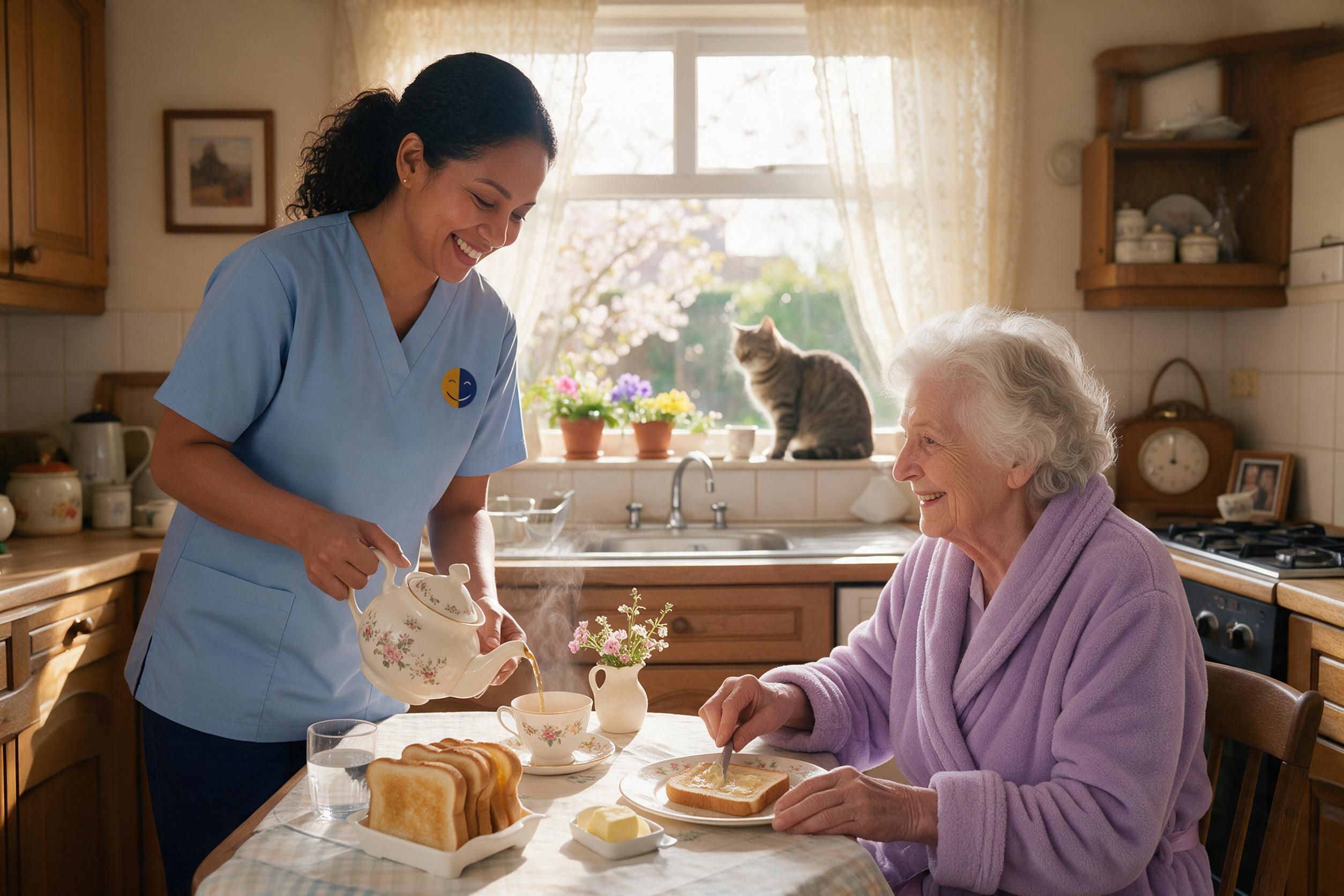
About this picture
The people on this page are imagined. “Joan” is 84 and lives alone with her cat in the house she has lived in for 40 years. She has arthritis and early dementia, and after a fall last winter her family worried about her managing alone. Her daughter lives an hour away. Joan’s day is an illustration of how live-in care commonly works, not the story of a real person, and every real day is planned around the person living it.
Morning: a gentle start
Joan has always been an early riser, so her carer is up by seven, has read yesterday’s notes and has the kettle on. A gentle knock, the curtains opened, and a cup of tea the way Joan likes it: milky, one sugar, in her own cup.
There is no rush. Joan washes at the basin with help to reach her back and feet, and chooses what to wear. Her carer checks her skin for redness, because sitting for long periods can cause pressure sores, and applies the cream prescribed by the GP. Morning tablets are given from the pharmacy pack, exactly as the care plan sets out, and recorded straight away.
Joan butters her own toast. It takes a little longer, but the care plan says she wants to keep doing what she can, and her carer knows that doing things for her, rather than with her, would slowly take her confidence away. The cat is fed. The radio goes on.
Late morning: getting out and about
On dry days, Joan and her carer walk to the corner shop for a paper and a chat with the shopkeeper. Joan uses her stick, and her carer walks on her weaker side. On other days there are the exercises her physiotherapist suggested, a look through the photo albums, or a trip to the hairdresser.
While Joan reads the paper, the carer puts on a wash, changes the bed and tidies the kitchen. Her daughter rings at eleven, as she does most days.
Lunch and the early afternoon
Lunch is at the table, together. Joan’s appetite has become small, so meals are little and often, with her favourite foods and a glass of water within reach. Her carer encourages a drink with every meal and every activity, because people living with dementia can forget to drink.
After lunch, Joan likes to doze in her chair with the television on low.
The carer’s daily break
In the middle of the afternoon, Joan’s carer takes their daily break: a walk, a phone call home, some time to rest. Joan’s risk assessment, agreed with her and her family, says she is safe on her own for a couple of hours at this time of day: she naps, wears a personal alarm pendant, and has her drink and the phone beside her. A neighbour pops in on Tuesdays.
If Joan could not safely be left, the break would be covered by a family member, a visiting carer or the provider. Breaks matter: a rested carer is a patient, observant carer.
Late afternoon and evening

Tea and a slice of cake at four, then something Joan enjoys: the crossword together, music from her dancing days, or ten minutes in the garden deadheading roses. Her carer has learnt that late afternoon is when Joan sometimes becomes unsettled, so the evening is kept calm and familiar.
Supper is a simple meal that Joan helps to prepare. Her daughter video-calls after supper. Evening medicines are given and recorded. Then a warm wash, nightclothes, teeth, glasses on the bedside table, the landing light left on, and the call bell within reach.
Before settling down, the carer writes up the day’s notes.
The night
Joan’s carer sleeps in the spare room next door, with the door ajar. Most nights Joan gets up once to use the toilet. The call bell rings, her carer helps her there and back, settles her, and goes back to sleep. This occasional help is part of live-in care.
If Joan began needing help three or four times every night, her carer could not rest properly and stay safe during the day. The provider would review the care plan with the family, and a waking night carer might be added.
Changeover day
Every few weeks, Joan’s second regular carer arrives for their turn. The two carers overlap for a proper handover: medicines, appointments, Joan’s mood, what she has enjoyed, and anything that has changed. Joan knows both carers well, so the change is a familiar face rather than a stranger.
What a daily record can look like
A short, clear note is kept every day. For example:
Tuesday. Joan slept well; up once at 3am for the toilet, settled quickly. Breakfast: toast and half a boiled egg. Morning tablets given 8.15am. Skin on heels checked, no redness, cream applied. Walked to the shop with her stick, steady. Lunch: soup and a sandwich, good appetite. Drinks: about six cups through the day. Rested 2 to 4pm, neighbour visited. Seemed a little muddled about the day of the week this afternoon; reassured with the calendar. Evening tablets given 6.30pm. Daughter called at 7pm. Happy and settled at bedtime.
With the person’s agreement, the family can see these records, and they help nurses, doctors and replacement carers understand what has been happening.
What to agree so days like this work
- A written routine for a good day, in the person’s own words where possible.
- Exactly what support is given with medicines, and how it is recorded.
- What the person can still do, and wants to keep doing, for themselves.
- When the carer’s daily break usually happens, and who covers it if needed.
- What happens at night, and what would trigger a review.
- Which housework is part of the role.
- How family will be kept up to date, and how often.
- How household money and shopping are handled.
Questions to ask about daily life
| Ask the provider | A good answer sounds like | Be cautious if |
|---|---|---|
| How will the carer get to know the person? | “We start with their history, routines and preferences, and keep learning from them and from you.” | The focus is only on tasks and timings |
| How do you keep the person as independent as possible? | Examples of doing things with the person, not for them | “The carer will do everything for them” |
| How will we know how things are going? | Daily records, regular contact and a named person to call | “No news is good news” |
| What happens if nights become disturbed? | “Tell us early; we review and add night support if needed.” | “The carer will manage” |
| How are changeovers handled? | A regular second carer and a full handover | A different stranger each time |
Signs the care needs a review
Ask the provider for a review if you notice:
- the person seems withdrawn, anxious, or not themselves with the carer;
- weight loss, signs of not drinking enough, or missed medicines;
- falls or near-misses;
- nights becoming regularly disturbed, or the carer seeming exhausted;
- the daily record becoming brief or vague;
- new needs after an illness or a hospital stay.
National guidance from NICE recommends that providers review a home care plan within six weeks of starting, then at least once a year, and sooner whenever needs change.
What to do next
- Write down what a good day looks like for the person, in their words.
- Share it with providers at the assessment, together with how nights usually go.
- Agree the points in the checklist above before care starts.
- Read about preparing the home and how live-in care works.
- Book a review for the first few weeks, then keep an eye on the signs above.
For free, independent advice about care, call Age UK on 0800 678 1602 or Independent Age on 0800 319 6789.
How we can help
Day and Nightcare provides fully managed live-in care anywhere in England, from £1,550 a week, and has supported people at home since 2008. We are registered with CQC and rated Good, and we care for people who fund their own care, people funded by their council (including through direct payments) and people funded by NHS Continuing Healthcare. If you would like to talk about what a day could look like for you or someone you support, call us on 01865 715780 to arrange a free initial assessment, or read about our live-in care and dementia care.
Common questions
Does a live-in carer do all the housework?
A live-in carer usually does the light housework connected with the person's care and comfort: cooking, washing up, laundry, changing beds, tidying and keeping the home clean and safe. Heavy cleaning, gardening, decorating, and cleaning or cooking for other members of the household are not usually part of the role. Agree exactly what is included at the assessment and write it into the care plan, so everyone knows what to expect.
Can family visit whenever they like?
Yes. It is the person's home, and family and friends remain as welcome as ever. Visits often lift everyone's spirits, and many families like to take the person out themselves. It helps to let the carer know when you are coming, so meals and outings can be planned, and to respect the carer's daily break and their room. If you visit regularly, you might cover the break yourself.
Can the carer come on holiday or to family events?
Often, yes, with planning. A live-in carer can support someone on a short break, at a family wedding or on a visit to relatives, if the provider agrees and the care plan is updated. Talk about the carer's travel, accommodation and meals, any extra costs, how the daily break will work away from home, and insurance. Give the provider as much notice as you can.
What if the person does not want help with personal care?
This is common at first and deserves patience. Many people find accepting help with washing or dressing difficult. Good carers build trust gradually, offer choices, protect dignity and follow the person's preferences, including whether they would prefer a male or female carer. An adult who has capacity can refuse care. If they lack capacity for that decision, the team will act in their best interests and review the approach with the family.
Sources and further information
- NICE: Home care, delivering personal care and practical support to older people (NG21)
- CQC: What can you expect from a good home-care agency?
- CQC: Regulation 9, person-centred care
- NHS: Help at home from a paid carer
- NHS: Personal alarms, monitoring systems (telecare) and key safes
Prepared by the Day and Nightcare care team. Last updated 30 October 2026; sources last checked 30 October 2026. This guide is general information about care in England, not financial, legal or medical advice.